The blog for Mets fans
who like to read
ABOUT US

Faith and Fear in Flushing made its debut on Feb. 16, 2005, the brainchild of two longtime friends and lifelong Met fans.
Greg Prince discovered the Mets when he was 6, during the magical summer of 1969. He is a Long Island-based writer, editor and communications consultant. Contact him here.
Jason Fry is a Brooklyn writer whose first memories include his mom leaping up and down cheering for Rusty Staub. Check out his other writing here.
Got something to say? Leave a comment, or email us at faithandfear@gmail.com. (Sorry, but we have no interest in ads, sponsored content or guest posts.)
Need our RSS feed? It's here.
Visit our Facebook page, or drop by the personal pages for Greg and Jason.
Or follow us on Twitter: Here's Greg, and here's Jason.
|
by Greg Prince on 22 October 2026 4:14 pm What’s good for the goose may be good for the gander, but what’s grist for the Grid didn’t do the Guardians any good this week. That’s my way of saying my recent exploration of Mets who were Brewers/Brewers who were Mets and how they fit into nine little boxes is about to receive a sequel stemming from the outcome of the American League Championship Series, and any appearance of any player connected with the baseball enterprise based in Northeast Ohio is purely coincidental.
Condolences to the Cleveland club for missing out on a trip to not just this feature but the World Series, with my specific regret focused on a good friend (North America’s finest birding wordsmith as far as I can tell) who’s been waiting to relish The Big One his whole life, what with his whole life having transpired since long after 1948. I’ve known a few Cleveland fans over the decades and I hope they get theirs someday. Had the Guardians won the AL pennant, I was ready to go full Cuyahoga in terms of Mets who were Indians-Guardians/vice-versa in Immaculate Grid terms. I was likely going to share my Tom Veryzer fascination, express my specific Harry Chiti frustration, and revisit that hardy perennial involving the mysterious decline of All-Star second basemen who came from there to here while leaving much of their ability there. Plenty of grist existed to celebrate a Guardians flag the way we celebrated the banner won by the Brewers.
Instead, with congratulations due to the American League champion Tampa Bay Rays, I have the team I must admit I really wanted for this feature, the team I really needed for this feature. The more reps I can devote to naming Mets who were Rays and Rays who were Mets, the better I oughta be at naming them when confronted by the challenge Immaculate Grid presents me every time it asks me for a Ray.
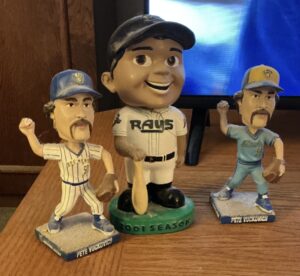 The Rays are about to get the Brewers treatment despite my being twice as familiar with the Brewers. The Rays are my Grid Kryptonite, ranking as my least favorite column or row header to encounter — them and First Round Draft Choice (thank goodness Gregg Jefferies changed uniforms several times). As noted previously, my personal rule is whenever possible, I have to use a Met to fill in my Immaculate Grid boxes. If, for example, I’m asked for a Tiger who was also an Astro, I will race to type in Rusty Staub. If I need a Red who was also a Cub, I will almost immediately think of Frank Thomas (our Original, not the Big Hurt) or, because I am the way I am, Mike Vail. Using only Mets when applicable on Immaculate Grid is my jam.
When I’m asked for any combination that includes Rays, my jam jar tends to come up practically empty. The reasons make sense to me, though they do not create answers.
• As they were founded in 1998, I did not grow up amassing Tampa Bay Devil Rays cards, thus I wasn’t exposed to dozens of individual player affiliations that never vacated my consciousness the way I just know Tom Tischinski was a Minnesota Twin in 1970 (and batted .191 for them in 1969).
• I have not seen the Mets play the Rays year in and year out forever and ever the way I have National League expansion teams of their general vintage. After the exclusive East vs. East alignment of early Interleague play and before the current state of everybody playing everybody, Mets-Rays series were infrequent. From 2002 through 2017, the Mets and Rays got together for all of three three-game sets.
• I’ve been to only three Mets-Rays games in person, each at least an era removed from the one it preceded or succeeded. Rick Reed flirted hard with a perfect game in 1998 (it was broken up by Wade Boggs). Brian Schneider hit his first home run of 2009 (the only time I sat in the very last row of Citi Field in the very last section of Citi Field, the fightin’ 538th). Blake Snell pitched into the eighth inning of a 3-0 shutout victory in 2018 (Snell would win the AL Cy Young with a 1.89 ERA and a 21-5 record that same season, the season Jacob deGrom went on to win the NL Cy Young with a 1.70 ERA and a 10-9 record).
I know the contours of the Rays/Devil Rays narrative. I respect the success they’ve achieved since sharply turning the corner from eternal cellar-dwellers to near-regular contenders in 2008. I’m happy they finally seem to have a new ballpark coming together on the side of Tampa Bay where they’d prefer to play. I always get a kick out of the Bay Area, as it calls itself, having a ballclub, since I went to college there in the years when MLB membership was a regional pipe dream. And I remain grateful that they enabled another glorious Elimination Day just this month.
But when push comes to shove, and Immaculate Grid asks me to name a Ray and, as Gene Rayburn would say, a “blank,” its’ my mind that goes blank as it seeks to make my answer a Ray who was also a Met. I’ve begun to train my mind to come up with such players, much the way the Mets used to train in St. Petersburg, but it hasn’t been second-nature. The fun of Immaculate Grid is so much of it is second-nature. I’m wandering through life aware that Lenny Randle played for not just the Mets, but the Rangers, the Mariners, the Cubs, and the Yankees. I’m on top of Jesus Alou’s travelogue from San Francisco to Houston to Oakland to Flushing. Damn right I instantly recall Tommie Agee was an Indian and White Sock before he was a Met, and an Astro and a Cardinal after he was a Met, but never actually a Dodger despite the umpteen-dozen TRADED cards I pulled in 1974 indicating he was about to summer in Chavez Ravine. These are the types of affiliations that stick inside the head.
But the Rays? Or even Devil Rays? The first player name, sometimes the only player name I can come up with on demand, is Evan Longoria, their version of David Wright. Unlike David Wright, Evan Longoria wasn’t a Met. So I can’t use him. The second name I come up with is usually Fred McGriff, probably because in addition to playing for Tampa Bay in their first several seasons, he’s actually from Tampa, neither of which is a fact that makes him a Met. so I can’t use him, either. Then I sit stumped groping for a third name.
Maybe I’ll have an AHA! moment and feel good about remembering Scott Kazmir, until I remember my caveat that my answer has to be someone who actually played for the Mets, and I only use Mets-adjacent answers when I absolutely can’t come up with the real thing. Mets-adjacent includes players who were Met minor leaguers but didn’t appear as one of our own in the majors (Pete Crow-Armstrong being the most nettling contemporary example); players who played elsewhere but managed or coached for the Mets (Frank Howard’s come off the bench for me on occasion); non-Met players who announced for the Mets (Ralph Kiner is as much a Met as anyone who’s ever lived); players who are relatives of Mets (I used Luisangel Acuña’s brother Ronald a couple of times until it made me feel unclean); New York Giants; Brooklyn Dodgers; and maybe New York Cubans for when Baseball-Reference’s makes one of its Negro Leagues forays.
Just this week, I got excited as I prepared to fill a box that asked for a Mariner and a Tiger with Bill Laxton, 1970s reliever of modest renown. Then I remembered Bill Laxton got only as far as Tidewater for us and had to let Mets-adjacent Bill Laxton go, much as Joe McDonald did when he threw him into the Rusty Staub-for-Mickey Lolich deal. It took a few minutes of seeking a substitute, but I somehow conjured 1988 deadline acquisition Edwin Nuñez from the mists of memory as a Tiger/Mariner/Met (Baseball-Reference calls him Ed Nuñez, the same way it insists on referring to Tommy Herr as Tom Herr, and Jimmy Piersall as Jim Piersall, but I’ll let that go as Joe McDonald and I did Bill Laxton).
Scott Kazmir, or rather the trade of Scott Kazmir, was a lightning rod in its day, him being a First Round Draft Choice with a presumably bright future ahead of him, only to have him and it sent by the Mets to the Devil Rays in 2004 because the Mets had to have Victor Zambrano, the kind of pickup you make when you’re convinced the veteran starter you’re acquiring is going to convert your realistic playoff dreams into reality. It didn’t work out that way in any way, except for the bright future for the guy we traded. Anyhow, Kazmir is Mets-adjacent, therefore not a full-fledged Mets/Rays answer for my purposes.
But I am getting better of late at knowing Mets/Rays in an effort to get better at naming Mets/Rays. The American League Championship Series provided a splendid backdrop to break out of my Rays haze, especially considering four members of their pennant-winning roster were previously Mets: Steven Matz, Cedric Mullins, Cole Sulser, and ALCS MVP Freddy Peralta…though it is possible this was a different Freddy Peralta from the one who pitched for the Mets earlier this season. If there could be two Bob Millers, two Bobby Joneses and, as mentioned in the Mets/Brewers piece the other day, two Mike Marshalls, there is a non-zero chance that there are two Freddy Peraltas gallivanting about Major League Baseball, each yielding vastly different results when he fires his fastball. Certainly the one we thought would be our ace in 2026 bore only a passing resemblance to the one who’s going to the World Series with somebody else.
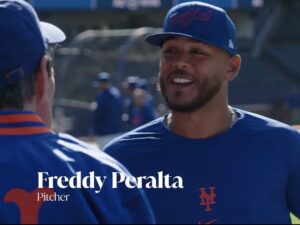 Probably not the same guy. On Tuesday, while the latter Peralta and those other Rays were in the process of wringing the champagne from their newly issued commemorative t-shirts, the Grid presented me with a Rays challenge, and I’m happy to report I responded to it with something approaching alacrity.
• The Grid wanted a Ray who played at least one game as a Ray as a third baseman. I came up almost instinctively with Ty Wigginton, who I should come up with a lot more often, honestly, since if Ty Wigginton were a cartoon character — and I always thought he resembled Nancy’s significant other Sluggo — he’d have toted around one of those suitcases covered in stickers attesting to how many places he’d been. Wiggy was also a Pirate (traded to Pittsburgh the same day Kazmir was sent packing), an Astro, an Oriole, a Rockie, a Phillie, and a Cardinal. His only misstep as a Met was his shoulder got tapped on by David Wright. Ty Wigginton knew how to take a hint and a hike.
 People often asked the same regarding Ty Wigginton. • The Grid wanted a Ray who was also a Red. Well, shoot, that sounded like a job for Asdrubal Cabrera, typical of the Mets/Rays oeuvre in that his Rayness occurred without my noticing it. When we got Asdrubal ahead of what turned into his 2016 MVM campaign, I thought, yes, I know him. He was with Cleveland. He played for the Nats, too. And I’ve maintained enough Asdrubal awareness to recall his post-Met time as a Phillie, a Ranger, a Diamondback, and a Red. But only through playing Immaculate Grid and looking up what players I could have chosen as answers have I learned or relearned he spent 2015 with Tampa Bay. That was his immediate pre-Met locale. I watched three Mets-Rays games on television in August of ’15. The record shows Cabrera played in all of them. Who knew? Not me for quite a while.
• The Grid wanted a Ray who was also a Dodger. Amazingly, it’s finally sunk in that Hideo Nomo played for Tampa Bay, the same franchise against whom Nomo made his Met debut in 1998. I remember that game at the drop of a hat. I remember Hideo’s Tornadic arrival in L.A. in 1995 and the shocking no-hitter he threw at Coors Field in 1996. I remember him making a comeback as a Red Sock (funny how so many players require a comeback once they’re done being Mets), throwing another no-hitter in 2002. I even dimly recall Hideo Nomo as a Brewer. The Rays part is yet again one of those data points I’ve gleaned from Gridding rather than organic memory. Don’t take it personally, AL champs. I also don’t remember Nomo as a Tiger or a Royal, but he was each of those as well.
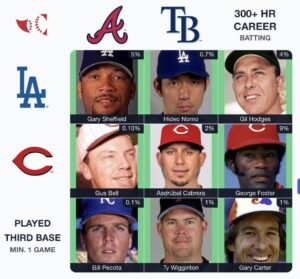 Getting better at this. I can feel my Mets/Rays muscles loosening. See what training does for you? Makes me ready to take the field at Al Lang. But that’s not what they do in St. Pete anymore. What they do is clinch pennants and inspire the naming of a bunch more Rays/Mets.
1. Cliff Floyd
When the Rays shed both their Devil and their futility in 2008, Cliff Floyd was as good a reason as any to root for them to win that year’s World Series. An even better reason was the Rays were playing the Phillies. That matchup didn’t work out to our satisfaction, but Floyd and spite did their best to light up Tropicana Field. The former Expo (which qualifies him in Grid-focused eyes as a National), Marlin, Red Sock, Cub, and Padre was as much the heart and soul of the Mets during his 2003-2006 stay as anybody. I steadfastly believe the healthier 2005 version of Cliff transplanted into 2006 would have powered us to ultimate glory twenty Octobers ago. Alas, they don’t let you rearrange impact as such.
2. Dwight Gooden
You already know how spectacular my favorite living Met was when he strode Apex Mountain in 1984 and 1985. You may not realize how much Immaculate Grid versatility Doc accumulated in his seventeen big league seasons. Depending on the corresponding row/column, you can fill Gooden’s name in when the Grid requests 2,000 career strikeouts; an All-Star appearance, large amounts of WAR, a no-hitter, a Silver Slugger from back when pitchers used to have the chance to earn one of those; even the dreaded First Round Draft Choice designation. Sadly, Doc won’t get you a correct answer for Hall of Fame or the square that seeks a one-team-only player (that’s what the likes of David Wright at one end and Dave Liddell at the other are for). Although it’s helpful for the Grid, I don’t love that Doc Gooden fits boxes labeled Guardians, Astros, Yankees (groan), and, yes, Rays. Dwight being from Tampa made his detour to the Bay a reasonable stop. Given how many Tampans the Devil Rays snapped up early on, I sometimes have to remind myself Gary Sheffield and Dave Magadan never played home games at Tropicana Field. But it would be cooler if they did.
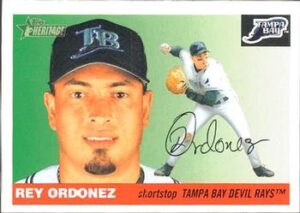 The Devil, you Rey! 3. The Devil Reys: Ordoñez and Sanchez
Rey Ordoñez isn’t that amazing an Immaculate Grid answer, given that he played for only three teams (though his three Gold Gloves represent useful trivial knowledge), but Mets Reys who were Devil Rays deserve some kind of acknowledgement. The Mets offloaded their greatest defensive showman ever on Tampa Bay following his 2002 comments deriding Mets fans’ mental acumen; he called those who booed him “stupid”. I never booed him, thus I never took his blanket dismissal personally. Rey Ordoñez was my wife’s favorite player during the Bobby Valentine years when Edgardo Alfonzo was my favorite player. Bobby Valentine was our favorite manager. Then, in one offseason, the Mets not only traded Rey-Rey for nobody in particular, they let Fonzie walk as a free agent and they dismissed Bobby V in favor of Art Howe. Anybody who replaced the Mets who almost went all the way in 1999 and 2000 was immediately suspect in my eyes. That included 2003 Met shortstop Rey Sanchez, who didn’t hit any better than the real Rey, certainly didn’t field as well, and allegedly received an in-game haircut from Armando Benitez, a follicular act that greatly offended Mike Stanton, who is an excellent Grid answer himself but someone I hesitate to use because a) I associate him with the pre-2003 purge (it took me a spell to warm to Cliff Floyd for the same reason); and b) his Grid photo shows him in a cap I don’t care to look at (I try to avoid using Robinson Cano for the same reason). Anyway, like Ordoñez, Sanchez was a Met, a Ray, and a Cub, but was also a Yankee (à la Stanton), a Giant, a Royal, a Brave, a Red Sock, and a Mariner. Plus someone who apparently couldn’t wait a few innings for his next trim.
4. Roberto Hernandez
I’ll say this for not the Mike Stanton who became Giancarlo Stanton but the Mike Stanton who stayed Mike Stanton: his associations with the Yankees and Braves are turnoffs, but he pitched for a lot of other teams (Red Sox, Rangers, Nationals, Giants, Reds) in addition to the Mets. That’s really all an Immaculate Grid enthusiast needs to value. It’s that form of peripateticism that makes Roberto Hernandez — not to be confused with the Roberto Hernandez who used to be Fausto Carmona — a Grid God. More than a thousand games pitched. More than 300 saves recorded. And a Ty Wigginton’s suitcase worth of affiliations: the Mets in 2005 and 2006; the Devil Rays from 1998 to 2000; and the White Sox, Giants, Royals, Braves, Phillies, Pirates, Indians/Guardians, and Dodgers somewhere along the way from 1991 to 2007 (a lot the same teams as the other Roberto Hernandez played for, though the former Fausto Carmona was never a Met). If you’re in a Grid pinch, refamiliarize yourself with relievers who populate the Baseball-Reference career leaderboards in saves and games pitched. Most of them got around, Quite a few dropped off their gear at Shea and Citi and began warming up. Or have you already forgotten that in 2026 Craig Kimbrel, he of 897 appearances and 441 saves, pitched for both the Mets and the Rays, not to mention the Royals? Kimbrel gained fame as a Brave, but was also a Padre, a Red Sock, a Cub, a White Sock, a Dodger, a Phillie, an Oriole, and an Astro. Grid Gods get around!
5. Rick White
Scott Kazmir for Victor Zambrano, and Freddy Peralta for convincing myself there may be two Freddy Peraltas notwithstanding, the Mets have been known to make a deadline deal with the Rays that helped them. Helped the Mets, I mean. In 2000, in their perpetual quest to shore up their bullpen, the Mets sent two of their previous First Round Draft Choice box-fillers, Paul Wilson and Jason Tyner, to Tampa Bay for Rick White and Bubba Trammell. White came north and took a little pressure off Messrs. Benitez, Franco, Wendell, and Cook, acquitting himself competently in 22 games over the final two months of the season, then eating up seven innings during the postseason. Rick remained a pen stalwart in 2001 before resuming his yeoman journey, one that began as a Pirate before he was a Devil Ray, then continued as a Rockie; a Cardinal; a White Sock; an Astro; an Indian; a Pirate again; a Red; a Phillie; an Astro again; and a Mariner. I don’t know if anybody ever called Rick White the righthanded Dennis Cook (he of the Giants, Phillies, Dodgers, Indians, White Sox, Indians again, Rangers, Marlins, Mets, Phillies again, and Angels), but from a Grid perspective, it fits.
6. Kelly Johnson
If you love in-season trades that don’t blow up in the Mets’ collective face, you gotta adore the Mets trading for Kelly Johnson in consecutive years, Johnson contributing as a guy who could do a little of everything, and the Mets making the playoffs both seasons, in 2015 and 2016. I can overlook him being pictured by BB-Ref as a Brave; hell, it’s where we got him from twice. In addition to NYM, ATL, and TBR (in 2013), Kelly’s itinerary included ARI, TOR, NYY (or MFY if you prefer), BOS, and BAL.
7. Michael Variations: DiFelice and Cairo
Prior to 1968, the Mets never had a player who went by Mike. Then along came local product Mike Jorgensen, whose two Met tenures covered three Met decades (putting him in the esteemed if trivial company of Tom Seaver, Alex Treviño, and David Cone). Since 2013, the Mets haven’t included among their ranks a player who goes by Mike, with local product Mike Baxter having broken the mold, not to mention sacrificing his body for the greater no-hit good the season before. Within the intervening 45 years, between the debut of the Mike who went to Francis Lewis High School in Fresh Meadows and the farewell to the Mike who went to Archbishop Molloy High School in Briarwood, the Mets were lousy with guys named Mike. Which is not to say their Mikes were lousy. Three of Rick White’s teammates on the 2000 National League champions were recent All-Star (if not for us) Mike Bordick, NLCS MVP Mike Hampton, and future Hall of Famer Mike Piazza. The biggest Mike in that group was still around in 2005 when we were even lousier with Mikes — no denigration intended.
The 2005 Mets had, at one point or another, Mike Piazza, Mike Cameron, Mike DeJean, Mike Matthews, and Mike Jacobs, none of whom was ever a Devil Ray or Ray. They even used their First Round Draft Choice on Mike Pelfrey, who somehow also missed Tampa Bay on the back of his baseball card. But Mike DiFelice of the 2005 Mets sure didn’t. This Mike had one of those backup catcher careers I’m not sure you see anymore. He played across thirteen major league seasons, never appearing in as many as 100 games in any of them. As a Met, he got into 32 contests spanning 2005, 2006, and 2007, his most memorable performance coming when he served as caddy to Piazza on that Mike’s final day in orange and blue. Willie Randolph made a show of sending No. 31 to his position, then removing him for one more standing ovation, replacing him with No. 33. No, not Matt Harvey or Ray Sadecki. DiFelice wore 33 in ’05, 6 in ’06, and 9 in ’07. The catcher who couldn’t keep a number and didn’t see much action as a Met was a Devil Ray from 1998 to 2000 and returned to St. Pete in order to call himself simply a Ray in 2008. There were also two terms as a Cardinal and one apiece as a Diamondback, Royal, Tiger, and Cub.
In the spirit of Mets-adjacent Grid answers, a Mike drop is warranted in the direction of Miguel Cairo, a handy utility type (certainly in Randolph’s eyes) whose first name might have been anglicized to Mike by Topps had he played in the days of Bob Clemente. During the golden age of Mikes, Miguel broke through as the first Met of his specific identity. Miguel Batista showed up around the same time as Mike Baxter. Miguel Castro played alongside Michael Conforto. No Met went as Michael until ex-Brave villain Michael Tucker slid into Shea in 2006. The Mike-Michael balance was en route to tilting in the 2010s and 2020s: Conforto, Cuddyer, Wacha (a future Ray), Perez, and Tonkin have all gone about answering to a slightly more formal version of Mike. Meanwhile, we were talking about Miguel Cairo, who besides being a Met (2005) and a Devil Ray (1998-2000) was a Blue Jay, a Cub, a Cardinal, a Yankee, a Mariner, a Phillie, and a Red.
8. Wilson Ramos
If Asdrubal Cabrera had been a catcher, he could have been Wilson Ramos, in that my surprise at realizing Ramos was a Ray is very similar to my surprise at Cabrera having been a Ray despite plenty of evidence that should have made it obvious. That last Mets-Rays game I attended, in 2018? Blake Snell’s catcher was Wilson Ramos. Asdrubal’s fellow Venezuelan had two hits and two runs batted in that day. The Mets’ starter was current Ray Steven Matz. Nope, had no idea Wilson Ramos was a Tampa Bay Ray. I remember Ramos pre-Met mostly as a National. He also got his crouches in with the Twins, the Phillies, the Tigers, and the last edition of the Guardians to be known as the Indians. As a Met, he could get in a groove. Wilson hit in 26 consecutive games during the Mets’ second-half surge of 2019, mounting a streak two games longer than Mike Piazza’s then-Met best, four games shy of Moises Alou’s enduring franchise standard from 2008. (Though to me, “Mets hitting streak” will always be synonymous with Mike…Vail, in 1975. because I am the way I am.)
9. Jose Bautista
We gotta feature within this feature one of those superstars who is widely known by baseball fans everywhere but probably not recognized as a Met or Ray by anybody who isn’t a fan of the Mets or Rays, and even then. Jose Bautista was the Blue Jays’ flagship slugger (give or take Carlos Delgado) when they were between pennants. He led the Jays who the Mets almost met in the 2015 World Series, the team we could have beaten in the 2015 World Series, because they were probably more susceptible to the charms of our pitching than the stupid Royals were. Ah, water under the grudge-bearing bridge. We actually had this Jose Bautista (there was another in the ’90s) on paper for a few minutes on trade deadline day in 2004. We got him from Kansas City (“boo hiss, I hate Kansas City,” my father said in one of the final cogent thoughts he shared me with during the winter following the 2015 World Series) only to include him in the package that made Ty Wigginton initially itinerant. Apparently most teams who had Jose Bautista didn’t realize what he could do. Brief stints with the Devil Rays, Orioles, and Royals preceded his Mets-Pirates transaction agate. Pittsburgh shipped him to Toronto in 2008. Jose went on to hit 288 regular-season home runs in a Blue Jays uniform and flip one bat somewhere toward Thunder Bay in the 2015 ALCS. In 2018, we got him not just on paper but for real, after the Braves no longer wanted him. He hit a walkoff grand slam for us before we traded him to the Phillies, his final MLB posting.
10. Rich Hill
As far back as he can remember, Rich Hill always wanted to be a gangster. Oh, I’m sorry, that’s Henry Hill in Goodfellas. I’m assuming that as far back as Rich Hill can remember, he always wanted to pitch for every major league team. Rich came relatively close. He moved from club to club so often, that it was funny. Funny how? What’s funny about it? Funny like he’s a clown, he amuses us? What the FUCK is so funny about Rich Hill’s career?
As Ray Liotta as Henry Hill said to Joe Pesci as Tommy DeVito (the gangster, not the former Giants quarterback), get the fuck out of here. It seems quite a few organizations said the same to Rich Hill, but just as many at some point said, “Welcome to our clubhouse, Mr. Hill. We would like you to pitch for us this week.” In 2021, the Rays and Mets shared Rich’s services. That was the righty’s 17th major league campaign. He’d already been a Cub, an Oriole, a Red Sock, an Indian, an Angel, a Yankee, a Red Sock again, an Athletic, a Dodger, and a Twin. Then he’d pitch four additional seasons as a Pirate, a Padre, a Royal, and a Red Sock twice more. In case you weren’t sure, Rich Hill throws the baseball with his left hand. I would use the past tense of throws, except can you ever really be sure lefthander Rich Hill won’t be active in the future? Not just an active senior (he’s only 46), but an active major leaguer. It’s funny how this guy stuck around everywhere for so long. And if you don’t at least consider Rich Hill as a potential Immaculate Grid answer when asked for a Met, a Devil Ray, or anything, it is you who may fold under questioning.
We’ve mentioned a Met-ric ton of Rays, and Rays’ed our Metsian awareness of the American League champs. And that was without saluting others who populated the Tampa Bay-to-Flushing Bay pipeline, worthy individuals of varying Grid utility who include but are not limited to Kelly Shoppach, Steve Trachsel, Damion Easley, Jason Isringhausen, Marlon Anderson, Lucas Duda, Brian Stokes, Jae Seo, Tommy Hunter, Cory Lidle, Aaron Loup, Brooks Raley, Tyler Zuber, Travis d’Arnaud, and the unsinkable Julio Franco (unsinkable being a desirable quality for anybody playing on a team with Bay in its name).
Once more, a resounding high-five to Baseball-Reference’s Multiple Teams search tool, found on its Frivolities page, for its assist in excavating myriad Mets-Rays/Rays-Mets names. Someday, if I keep at my training, I won’t need to look up quite so many.
by Greg Prince on 17 October 2026 4:57 pm My primary rule for playing Sports Reference’s Immaculate Grid — my “self-imposed gamification,” as it’s been labeled — is I have to fill every box that can be filled by a Met with a Met. Does the Grid call for a Phillie who also played for the Pirates? Then I have to answer with a Met who played for the Phillies and the Pirates, which is when I’m suddenly delighted to recall Richie Hebner played for the Mets. If I need an Oriole who also played for the Giants, that means Armando Benitez is not a trigger for flashing back to late-season and postseason meltdowns, but a handy name to skim from the tip of my brain. Or I could use Hobie Landrith, because without the catcher the Mets chose first in the 1961 expansion draft, your Grid is going to have a lot of passed balls.
With the Milwaukee Brewers having swept the Los Angeles Dodgers to capture their first pennant in 44 years, not to mention their first as a National League representative, I thought it appropriate to honor them by naming some Brewers who were also Mets, specifically players who make for impeccable Immaculate Grid answers, which is to say players who played for the Brewers, the Mets, and a bunch of other teams. Having these kinds of guys top of mind is the key to filling boxes and keeping scores manageable. The more obscure the connection, the fewer of your fellow Gridders will pick him, the lower or better your score will be. I’m not a nut about getting the lowest score possible, but I like to avoid obvious answers. Obvious answers seem to include Nolan Ryan, Pedro Martinez, and Justin Verlander, to name three guys who seem to regularly check in as the most popular answers on a given day that they are boxworthy.
I’m getting in the weeds here. I want to get into the hops and barley, instead. I want to get into Brewers who were Mets.
1. Tommy Davis
Sports Reference is kind enough to let me know that by far my most deployed player in Immaculate Grid is Tom Seaver. I don’t mind that he’s an obvious answer when a Met is asked for. I don’t mind that he therefore drives my score up. He’s Tom Seaver. He’s my favorite player ever. I like typing his name in. But my favorite Immaculate Grid answer, and my second-most deployed player, is Tommy Davis. Tommy Davis had a spectacular Immaculate Grid kind of career. It was long, it was distinguished, and he played for a lot of teams. For my baseline purposes, he was a Met, in 1967. For the purposes of this feature, he was a Seattle Pilot, which in the eyes of Immaculate Grid qualifies him as a Milwaukee Brewer, for Immaculate Grid follows franchise bloodlines. The Grid asks for a Washington National, you can enter a Montreal Expo. The Grid asks for a Minnesota Twin, you can enter a Washington Senator from before 1961. The Grid asks for a Texas Ranger, you can enter a Washington Senator from 1961 to 1971. The Grid has a memory that way.
If you need a Met who was also a Brewer, Tommy Davis is your man. If you need a Met who was a Dodger, a White Sock, an Astro, an Athletic, a Cub, an Oriole, an Angel, or a Royal, Tommy Davis continues to be your man. If you need any combination of those teams, Tommy Davis is ready to bat. Also, if you need somebody who was at some point an All-Star, somebody who compiled a .300 season batting, somebody who collected 2,000 or more career hits, or somebody who played every position other than pitcher, catcher, or shortstop, (the Grid sometimes goes there), you will develop a profound appreciation of Tommy Davis. Not that you shouldn’t already have one.
2. Mike Marshall
That’s Mike Marshall, 1967-1981, not Mike Marshall, 1981-1991. The Grid is aware enough to differentiate them. You want the older Mike Marshall, the pitcher Mike Marshall. The Mets wanted Mike Marshall at the rear of his career, long after he’d been a Pilot/Brewer, before which he’d been a Tiger. He was also an Astro, but got famous as an Expo, pitching basically every day. The Dodgers traded for him, and he pitched even more, cresting at a record 106 appearances in 1974, which catapulted him to the Cy Young Award when relievers were just beginning to be taken seriously. Marshall had lots of opinions, which meant he’d be sent to lots of different teams once his previous employers tired of his input. He’d go on to be a Brave, a Ranger, and a Twin. For Minnesota he’d post a career high 32 saves at age 36; the Grid occasionally asks for a 30+ save guy. Mike’s Metsdom encompassed only the second half of split-season 1981, but he made it into the last 20 games of his career from the middle of August to the beginning of October, a workhorse to the end.
3. Jesse Orosco
Because Jesse Orosco holds such an outsize place in our consciousness for throwing his glove in the air following strikeouts that ended two notable sets of games in 1986, he might not leap to mind as the kind of journeyman who makes a great Grid answer. Ah, but after Jesse finished his tenure with us in 1987, he was off and journeying, evolving from 30+ save closer into the kind of lefty who could always hold down a place in somebody’s bullpen for a spell. To us he’s Jesse Orosco of the Mets. To the Grid, he’s also Jesse Orosco of the Brewers, not to mention Jesse Orosco of the (deep breath) Dodgers, Guardians neé Indians, Orioles, Cardinals, Padres, Yankees, and Twins. That last stop recognizes Jesse’s final handful of major league innings in 2003, though that same organization is where his minor league career began in 1978, just prior to the Mets accepting him as the player to be named later in exchange for Jerry Koosman. And here we are naming Jesse Orosco much later.
4. Ken Sanders
Baseball Digest brought Ken Sanders of the Brewers to my attention in 1972, spotlighting him as one of the American League’s best relievers on the heels of his AL-leading 31 saves in ’71. Naturally, I was excited the Mets got him in 1975, because as a kid, if I had one piece of statistical information to chew on, I let the flavor linger for years. In between he’d been a Twin, a pre-Guardian, and an Angel. Earlier he’d been an Athletic (separate tenures in Kansas City and Oakland) and a Red Sock. He’d end as a Royal. As a Met, Ken recorded six saves, and the only thing I really remember about his Shea stay was John Stearns hit him in the face with a ball the catcher was simply throwing back to the mound in the course of Ken warming up. I’m still excited we got him.
5. Skip Lockwood
I suppose I could think of Ken Sanders without thinking of Skip Lockwood, but I usually don’t. They were Brewer relievers together. They were Met relievers together. Lockwood was our closer when that job was called fireman. He started as an infielder for the Kansas City A’s, then became a pitcher for the Seattle Pilots, which meant, by lasting from 1969 to 1970, he became a pitcher for the Milwaukee Brewers. There’d be short stints for the Angels and Red Sox as well. I had the pleasure of meeting Skip in 2019. A very nice man with a very interesting book.
6. Doc Medich
I love that Doc Medich qualifies for my Grid needs all based on a single waiver-enabled Met appearance in 1977, in the final week of the season, kind of a free agent audition that didn’t go great, thus he went elsewhere. Perhaps my favorite statistic I’ve ever uncovered is Doc pitched for three teams in ’77, and every one of them — the Mets, the Mariners, and the A’s — lost 98 games. The future doctor his parents called George began the sporting side of his professional life with the Yankees. They traded the medical school student everybody else called Doc to the Pirates for a package that included Dock Ellis. Ellis pitched better for the Bombers than Medich did for the Bucs, leading to one of the great overheards in the Shea Stadium press box from a 1976 night that Medich struggled versus the Mets, shared by Roger Angell: “Ellis is a better doctor than this guy!” The Met detour preceded a contract from the Rangers, with whom he settled in from 1978 until the Brewers picked him up for the stretch drive of their first league championship season. Doc’s final operation on the mound came in the 1982 World Series.
7. Jeromy Burnitz
Jeromy Burnitz is my go-to Met who was a Brewer/Brewer who was a Met. I’m still sore Dallas Green wished to give up on him so quickly, instigating his trade to Cleveland (albeit for a decent haul of pitchers in Paul Byrd, Dave Mlicki, and Jerry Dipoto). The Indians gave up on him too soon, too, shipping him to the Brewers where Jeromy found his ideal situation. Burnitz flourished as a Brewer, walloping 163 homers over six seasons. I always assumed he was a perfect fit in Milwaukee because no Brewer this side of Gorman Thomas looked like he could make the Barrelman costume a second skin. Our former first-round draft choice returned to the Mets in 2002, and that went as well as those things usually do. In 2003, the Dodgers took him off our hands. In rapid succession, Jeromy joined the Rockies, the Cubs, and the Pirates, not knowing his journey was taking him up the Grid utility ladder.
8. Mike Cameron
My quaint 20th-century notion of a guy being too good to play for everybody crashes up against the realities of baseball players’ agency in the 21st. Shouldn’t somebody who was good for 278 home runs, 297 stolen bases, and three Gold Gloves as a sterling center fielder have found something approximating a forever home? Mike Cameron was a White Sock who became a Red; a Red who became a Mariner (Cincy had to give up somebody of quality to obtain Ken Griffey, Jr.); a Mariner who signed to become a Met before the Mets could convince Carlos Beltran to do the same; a Met who became a Padre once Beltran made Mike’s Metsiness obsolete; and a Padre before becoming a Brewer, which is one of those associations I would have forgotten about had I not gotten hooked in 2023 on doing Immaculate Grid every single day of my life. Oh, he was also a Red Sock and a Marlin. Cameron put up 46.7 in Baseball-Reference WAR over 17 seasons, which I note because the Grid likes to ask about career bWAR that tops 40.
9. Dana Eveland
I’m throwing in Dana Eveland here because I’d like him to stick to my Grid thought process. Relievers who travel are Grid gold, and I never remember to think about our 2014 lefty who started as a Brewer in 2005 and proceeded to also pitch for the Diamondbacks, A’s, Blue Jays, Pirates, Dodgers, Orioles, Braves, and Rays. I don’t believe I knew who Dana Eveland was before 2014 and I rarely revisited his career after 2014. In going about my Gridness, my head generally races to the era when Ken Sanders and Skip Lockwood strode major league mounds. Probably has something to do with being a kid, collecting baseball cards, and everything from then making an impression. Their successors down the corridors of time never left me a cardboard trail, and it’s been ages since my Baseball Digest subscription lapsed. But I know Dana Eveland was a Met, and I’ve decided to know he was a Brewer.
10. Jose Quintana
I loved this guy as Met in 2023 and 2024. I first grew familiar with him as a White Sock in the early 2010s. It never occurs to me while I make my Grid rounds that he pitched for the Cubs, the Angels, the Giants, the Pirates, the Cardinals, the Rockies, and, yes, the Brewers. Teams wanted Jose Quintana, a native of Colombia (the Grid sometimes asks about birth nations). I was tickled to have Jose Quintana. I really should fill his name in more often, yet my consciousness can retain only so many names in those minutes every morning when I’m taking my Grid swings.
I gotta stop somewhere. Cap tips are due to, among quite a few others, Gary Sheffield, Jose Cardenal, Jonathan Villar, Dwight Bernard, Willie Randolph, Nelson Figueroa, Lenny Harris, Francisco Rodriguez, Wayne Twitchell, Curtis Granderson, Ray Sadecki, Danny Frisella, Bill Pulsipher, Livàn Hernandez, Gary Sanchez, Mike DeJean, Glendon Rusch, Bob McClure, Tim Leary, Juan Acevedo, LaTroy Hawkins, Rick Cerone, Mark Canha, Neil Walker, Tony Fernandez, Darryl Hamilton, Jose Valentin, Mark Bomback, Fernando Viña, and Charlie O’Brien, all of whom are fine Met/Brewer options. Good luck to Milwaukee in its quest to celebrate a World Series title for the first time since the Braves brought one home in 1957. Milwaukee Braves don’t count in the scheme of Met/Brewer Grid answers, but they do for Mets/Braves. As do Mike Marshall, Dana Eveland, Gary Sheffield, Ray Sadecki, Danny Frisella, Rick Cerone, and Charlie O’Brien.
Big ups to Baseball-Reference’s Multiple Teams search tool, found on its Frivolities page, for its assist in reeling off those names at the end. I may be blessed with an expansive Met memory, but the top of my head ain’t THAT big.
by Greg Prince on 10 October 2026 4:12 pm In the opening weeks of a Mets offseason we hope doesn’t linger beyond the forthcoming winter, we have learned a new phrase, “uncapped downside scenario,” courtesy of David Stearns, who for his next press conference might want to assign one of the staff interpreters to translate his fluent POBOese into English. To be fair, Stearns was talking about the 2026 Mets, so we could pretty easily infer the meaning of his words without the services of Alan Suriel or Hiro Fujiwara.
We have also been told we can forget the identities of three coaching staff members (not necessarily coaches), Jeff Albert, Danny Barnes, and Kevin Mahoney, the respective former titles of whom — director, major league hitting; quality assurance coach; and batting practice pitcher — represent three jobs that I don’t believe would have been included in an official team communiqué a decade or so ago. Director, major league hitting, and quality assurance coach come out of the same executive glossary that gives us uncapped downside scenario. And authorizing a missive to announce the batting practice pitcher wasn’t properly grooving them down the middle or, for all we know, throwing too many meatballs seems rather postmodern, too.
Twelve teams entertained their fans by playing more baseball following the last game of the 2026 regular season. We’ve made do in the shadow of other people’s playoffs with linguistic gymnastics. Still, especially in October (no matter how Metless), how can you not be romantic about baseball?
For example, how can you not be romantic about baseball when baseball gave us not only Ralph Kiner in the Mets broadcast booth for 52 seasons but Ralph Kiner in a comic book? Ralph Kiner was a big enough deal in his Pittsburgh Pirate playing prime to rate the cover of the August 1951 Sports Action #8. Directly within awaited “the stirring story” of the “the Pirate slugger whom the experts pick to smash Babe Ruth’s home run record this season!” Ralph had just come off seasons of 54 and 47 home runs, so why not a larger-than-life 61 or more? Alas, Ralph’s total dipped to 42 in ’51, still good enough to again lead the National League.
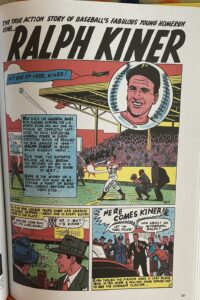 Ralph’s reign as the idol of young America is lovingly captured amid the sumptuous Atlas Comics Library collection of Sports Action titles, recently published by Fantagraphics Books on license from Marvel. A comprehensive introduction from medium maven and Friend of FAFIF Dr. Michael J. Vassallo, explains sports-themed comics were “a niche market even in their heyday,” yet there they were on the newsstand alongside all the day’s periodicals. A kid drawn in by the drawing of Ralph on the cover in the late summer of ’51 may have very well had that very comic book within reach as Bobby Thomson swung for immortality and the Polo Grounds fences a few weeks later. It was a time when baseball stars were national heroes, and you can feel that exalted status jumping off the pages of Sports Action. The very same issue that put Ralph on a pedestal also gave iconic treatment to future Met Warren Spahn and one of Ralph’s eventual New York broadcasting counterparts, Phil Rizzuto. Other installments bring us into comic contact with incandescent legends like Jackie Robinson, hallowed names like Hack Wilson, and stalwarts like Red Schoendienst, hailed in the February 1950 Sports Action as “the most under-rated second sacker in baseball!” yet not so under-rated that he wasn’t selected to sparkle among this galaxy of stars. (Red, Hack, and Jackie, like Ralph, Spahnie, and the Scooter, are all in the Hall of Fame.) Ralph’s reign as the idol of young America is lovingly captured amid the sumptuous Atlas Comics Library collection of Sports Action titles, recently published by Fantagraphics Books on license from Marvel. A comprehensive introduction from medium maven and Friend of FAFIF Dr. Michael J. Vassallo, explains sports-themed comics were “a niche market even in their heyday,” yet there they were on the newsstand alongside all the day’s periodicals. A kid drawn in by the drawing of Ralph on the cover in the late summer of ’51 may have very well had that very comic book within reach as Bobby Thomson swung for immortality and the Polo Grounds fences a few weeks later. It was a time when baseball stars were national heroes, and you can feel that exalted status jumping off the pages of Sports Action. The very same issue that put Ralph on a pedestal also gave iconic treatment to future Met Warren Spahn and one of Ralph’s eventual New York broadcasting counterparts, Phil Rizzuto. Other installments bring us into comic contact with incandescent legends like Jackie Robinson, hallowed names like Hack Wilson, and stalwarts like Red Schoendienst, hailed in the February 1950 Sports Action as “the most under-rated second sacker in baseball!” yet not so under-rated that he wasn’t selected to sparkle among this galaxy of stars. (Red, Hack, and Jackie, like Ralph, Spahnie, and the Scooter, are all in the Hall of Fame.)
There are a lot of sports covered in Sports Action. Knute Rockne rumbles in to represent college football. Man O-War gallops over from horse racing. And if you prized fighters, you had to be sweet on Sugar Ray Robinson, “the man other fighters fear!” Exclamation points were not in short supply at Sports Action As this collection shows, sports were something to get excited about, your cynicism checked at the door. As one fan in the stands says while watching high school-age Ralph attract scouts’ attention, “Kiner looks great today!” Few ballplayers ever looked better than they do in Action Comics.
Comic books helped you see your favorite ballplayers before television totally took hold as the baseball delivery vehicle of choice. Radio still does that. We wouldn’t have bordered on verklempt during the final broadcasts of Howie Rose in September if baseball over the airwaves (absorbed traditionally or through a digital device) didn’t continue to transmit a certain romance about the game. TV existed in 1951, but the signal event of that year — in baseball, in America — lives on because of a radio call. Kid, put down that Ralph Kiner comic and listen up:
“Here’s Bobby, waiting. Branca throws…”
I know you’re expecting Russ Hodges over WMCA (later home of the Good Guys and, for five seasons, flagship station for the Mets) to inform you several times consecutively that the Giants win the pennant, but on YouTube you can hear how the deciding game of the 1951 National League playoff went down the way it was heard in much of the country, via Gordon McLendon on the Liberty Network. It’s a longer broadcast excerpt than you’re used to hearing from Hodges, and it’s a treat. Brother, does McLendon bring the drama, not just to the swing of fate, but to “the final count, the last mile, the last half-inning,” everything from the bottom of the eighth through Thomson’s trip around the bases.
The Dodgers, after increasing their lead to 4-1, “may have just served the death warrant”. Those Brooklyn fans who ventured up to Coogan’s Bluff “roar, roar, roar.” They’re beginning to celebrate, “perhaps a little bit precipitantly”. On the “valorous” Giants side, Bill Rigney is “the basket boy” (for the manner in which he caught popups, with fielding prodigy Willie Mays taking notes); Hank Thompson is “Donkey”; Eddie Stanky is “Leo’s pride and joy” as well as “a dangerous clutch man”; and Whitey Lockman is “the Carolina Towhead,” because “Whitey” isn’t enough of a nickname. Well before the conclusion of this echoing evergreen candidate for Greatest Game Ever Played, McLendon marvels, “Boy, I’ll be seven sardines in a size-six can if this isn’t a honey.”
Kid, don’t put down this column, but do listen to McLendon take you on a tour of what baseball sounded like at the peak of its National Pastime powers. Baseball always sounds special in October, what with so much on the line. I love seeking out the hometown broadcasts from the postseason combatants in Octobers when the Mets are at liberty (which is most of them). I love tuning into the national radio broadcasts for their touch of gravitas. And I love hearing about what it’s been like on the inside of those booths.
Henry Lenz, longtime Friend of FAFIF (we do attract a nice crowd), turned on the mics, so to speak, at a Substack he dubbed Still Rolling, a multimedia journal devoted to his career as a radio engineer for CBS and his affection for the vehicle that has taken so many of us to so many ballgames with just our ears and our imagination.
“There’s something timeless about Baseball on the Radio,” Henry shared earlier this season. “Long before high-definition screens and endless replays, the game lived in sound — the crack of the bat, the rise in the announcer’s voice, and the pictures your mind created on its own. In my case, not just listening — but having the rare privilege of sitting behind the sportscasters & microphones, helping bring those moments to life.” The All-Star Game. The World Series. The little matter of an earthquake disrupting the Fall Classic. He was an essential part of bringing audio to enormous audiences annually.
Henry worked closely with many of the greats, in baseball (Vin Scully!) and in news (Walter Cronkite!), and is generous with his recollections, one of which will transport you to the night we knew we’d never forget the name Bill Buckner. Roll on over to Still Rolling and don’t hesitate to raise the volume…unless you’re sneaking his Substack under your pillow, transistor-style.
One of the greats in the art of telling you what’s going on in a game is Mike Breen, a New York radio veteran who’s become synonymous with the NBA on TV. He’s also one of the great celebrity Mets fans, not just because he’s a celebrity and a Mets fan, but because (as you could tell when sat in with Gary and Keith in late August) he adores the Mets so sweetly and innocently, and the fact that his fame opens the doors for him (like getting to sit in with Gary and Keith) hasn’t depleted a scintilla of his wonder at getting to be around his favorite ballclub once in a while. Mike, like our pal Henry, has an Amazin’ story from being on what we’ll call Radio Row at Shea on October 25, 1986. Absorb a basketball voice’s baseball reflections at Like It Oughta Be, Mark Simon’s evocative championship anniversary newsletter.
Video has its own place in the romantic scheme of baseball, of course. YouTube recently sent us a Valentine of sorts, when it hosted the posting of The Lighter Side of the Mets, a digitization of a VHS celebrating the Mets for their inherent wackiness. This was produced in the late 1980s, when the kicking of a ball around by any given Met was viewed as an artifact of the past and an aberration in the present. The Mets hadn’t won a World Series in two going on three years, so nobody had yet linked the name Buckner to a potential uncapped downside scenario (writer Tim Josephs makes such a curse case here). I ate up the Lighter Side presentation for how many Original Mets it got on the record while they were still hale, hearty, and immersed in baseball. Bob Murphy narrates. Tim McCarver is heard. Plus a couple of dollops of youthful Mets broadcasters Gary Cohen and Howie Rose are in evidence.
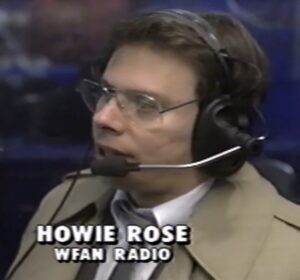 Howie’s name keeps coming up here, doesn’t it? Why shouldn’t it? He’s been in our ears for decades and on our minds all year. We were dismayed when he announced his impending retirement in March, daring to relish other aspects of his life in his seventies. We were delighted when we learned he fulfilled his 62-year-old wish and got to meet a Beatle — Paul McCartney — in May. We didn’t mind getting a little damp in service to saying goodbye to him on a rainy September weekend. Paul, when he led Wings, advised us to listen to what the man said. When Howie spoke, that’s what we did. Howie’s name keeps coming up here, doesn’t it? Why shouldn’t it? He’s been in our ears for decades and on our minds all year. We were dismayed when he announced his impending retirement in March, daring to relish other aspects of his life in his seventies. We were delighted when we learned he fulfilled his 62-year-old wish and got to meet a Beatle — Paul McCartney — in May. We didn’t mind getting a little damp in service to saying goodbye to him on a rainy September weekend. Paul, when he led Wings, advised us to listen to what the man said. When Howie spoke, that’s what we did.
I heard another valued voice on that final Sunday Howie was going to be on the job. Just as my tickets were being scanned, somebody still getting her bag checked by security called out to me. It was Stefanie Brand, a fine person in her own right, but someone I was compelled to introduce to my Stephanie as “Dana’s sister”. In turn, Stefanie introduced me to the person she was with as “Dana’s friend”. If you’re still defined by your relationship to Dana Brand in 2026, even if it’s just for a minute, you must be doing something right.
We chatted for a bit while standing in the Rotunda, not too many feet from where I last bumped into Dana, in 2011. That wasn’t supposed to be our last meeting. Dana Brand wrote regularly and eloquently about the Mets from the mid-2000s to the early 2010s before passing without warning. Fifteen years since he’s gone, and I continue to miss him. Had he been around on September 20, I know he’d either have trekked to Citi Field for Howie Rose’s final game or sat next to a radio to listen to what the man was saying. Then soon I’d be reading what this man I was lucky to know thought about what he saw/heard.
The next best thing I could do was, once I got home from Closing Day 2026, was pick up Dana’s 2007 book Mets Fan and turn to his essay titled simply “Howie Rose,” the conclusion of which, frankly, haunts:
“I hope I get to listen to Howie forever. I think he’s exactly my age. Despite the rigors of the job, and all the travel, people who are lucky enough to get to be baseball announcers seem to want to do it until they literally no longer can. So Howie’ll be working a lot longer than I will be. I’ll listen to him when I’m retired. I’ll envy him and enjoy him.”
Dana’s thoughtful appreciation of Howie reminded me that Richie Ashburn — still very much in his prime as a Phillies announcer when he appears in that Lighter Side video warmly recalling his 1962 Mets experience — died in a Manhattan hotel room amid a Mets-Phillies series he was working in 1997. He was lucky enough to talk baseball on the air and did it until he literally no longer could. I remember sentiments from around that time from baseball announcers who by then had been around forever, which absolutely described Ralph Kiner and Bob Murphy, to the effect that they did not want to meet their end like Ashburn had. Maybe that’s something that imprinted on Howie, who by then was in his second decade associated with Mets broadcasts and in his second year as the voice of the Mets on Sportschannel. He’d go on to experience the rigors of a baseball schedule and a hockey schedule over and over. He gave up the travel. He never let go of the romance. The romance is what keeps us attached to this game and this team in whatever capacity we choose to hold on.
Dana, like Howie, was clear-eyed about the thing he loved. “I like how Howie can get annoyed,” Dana wrote in Mets Fan. “It’s good to have a baseball analyst or announcer who can call crap for what it is, who can say, like Howie says, ‘Oh come on…’” As the author noted, we wouldn’t have gotten such bracing honesty from one of Howie’s mentors. “In Murph’s world,” Dana insightfully added, “people could not be called out for their crap. He might say ‘my, my,’ or ‘what a shame,’ but he wouldn’t do what Howie does. Howie will complain, forthrightly, about what should be complained about.”
As an English professor, I’m certain Dana would have had a ball parsing “uncapped downside scenario”. As a Mets fan, I’m confident he would have called out David Stearns on quite a bit of the crap that led to the uncapping. Sometimes we can’t help but be attracted to what we disdain, maybe because we think we can somehow take a sad situation and make it better, maybe because we just embrace the opportunity for catharsis. As another announcer, Joe Garagiola, famously said of baseball, romance is a funny game.
by Greg Prince on 8 October 2026 12:12 pm “I still get such a bang out of it,” John Cusack as Buck Weaver says late in Eight Men Out, the cinematic telling of the scandal that engulfed the 1919 Chicago White Sox, a team that was eliminated in the postseason, ostensibly because they weren’t trying to win. I thought of that line Wednesday night when the 2026 New York Yankees were eliminated in the postseason, despite presumably trying to win. The final out of Game Three of the American League Division Series — a sweep by the Tampa Bay Rays — activated the annual municipal observance of Elimination Day, a bacchanalia of Sheadenfreude for New Yorkers who prefer their late Octobers and early Novembers free and clear of ticker-tape if it’s not falling directly on us.
Though the first recorded celebration of Elimination Day took place in 2005, with festivities on some scale recurring every autumn save one since then, the inaugural modern gala surrounding the end of the Yankees’ chance to reign as world champions occurred in 1997, when the Cleveland baseball club then called the Indians ousted the defending titleholders in the fifth game of that year’s ALDS. The Yankees did not go down easily. Trailing, 4-3, at Jacobs Field, the team from New York got the tying run to third base in the eighth and, with two out in the ninth, another potential knotting tally to second via a Paul O’Neill double. The exhalation and exultation that followed when the next batter, Bernie Williams, flied out to left to end the game and championship defense reflected the sense of liberation inherent in the moment.
It also proved prophetic in its way, for the reaction seemed to take into account that Elimination Day 1997 better be enjoyed, for there wouldn’t be another one until 2001, the legendary Game Seven of that season’s World Series. The Arizona Diamondbacks’ triumph in the name of all that is good presaged the first golden age of Elimination Days, those wrought by the 2002 Anaheim Angels, the 2003 Florida Marlins, and the 2004 Boston Red Sox, each, like the ’01 D’Backs, a worthy world champion.
 It’s getting to be old but attractive hat. By the time Elimination Day was penciled onto the baseball calendar in ’05 (another gift from the Angels), the sincere appreciation evinced for its existence nearly every October remained, yet the emotional heft associated with the widespread expression of gratitude may have begun to diminish at the edges. The 2004 Elimination Day celebration, considered the granddaddy of them all, what with the Red Sox rebounding from an 0-3 ALCS deficit to take four straight and clinch the pennant at Yankee Stadium, proved difficult to match in the years ahead. Those who continued to celebrate, via the playoff victories of the 2006 Tigers and 2007 Indians and other worthy squads in the early 2010s, nonetheless remained steadfast in their observance.
Scholars say the contemporary era of Elimination Day emerged around 2017, with the tone attached to the holiday growing more subdued than in its Golden Age heyday, thanks to its eventual routine nature. Every year the coming of Elimination Day could practically be counted on. An element of predictability set in. Veterans of the Elimination Day movement were never fully certain it would show up and therefore refused to take it for granted, but those might have been instincts tempered by the 1996-born dynasty, disciplined by the hard and bitter 1998-2000 threepeat speaking, to say nothing of the notion that any team that makes the playoffs can conceivably go all the way. Make no mistake, however: The fact that you can almost surely count on Elimination Day coming around again doesn’t provide any less of a bang when it does come as we edge toward the late 2020s.
Why, it’s almost as if you can reach out over a high fence and touch Elimination Day when it descends toward the palms of your hands. But you shouldn’t do that, for they have video replay now and can call spectator interference on you.
ELIMINATION DAY HONOR ROLL, 1921-2026
1921 New York Giants
1922 New York Giants
1926 St. Louis Cardinals
1942 St. Louis Cardinals
1955 Brooklyn Dodgers
1957 Milwaukee Braves
1960 Pittsburgh Pirates
1963 Los Angeles Dodgers
1964 St. Louis Cardinals
1976 Cincinnati Reds
1980 Kansas City Royals
1981 Los Angeles Dodgers
1995 Seattle Mariners
1997 Cleveland Indians
2001 Arizona Diamondbacks
2002 Anaheim Angels
2003 Florida Marlins
2004 Boston Red Sox
2005 Los Angeles Angels of Anaheim
2006 Detroit Tigers
2007 Cleveland Indians
2010 Texas Rangers
2011 Detroit Tigers
2012 Detroit Tigers
2015 Houston Astros
2017 Houston Astros
2018 Boston Red Sox
2019 Houston Astros
2020 Tampa Bay Rays
2021 Boston Red Sox
2022 Houston Astros
2024 Los Angeles Dodgers
2025 Toronto Blue Jays
2026 Tampa Bay Rays
With eternal thanks as well to those who did their part in seasons from 1903 to 2023 in which Elimination Day was a less formal yet no less valued affair.
by Greg Prince on 3 October 2026 6:20 pm In honor of the 75th anniversary of The Bobby Thomson Game, the 27th anniversary of The Melvin Mora Game, and the anniversaries of a few other things that happened on October 3 before Pete Alonso redefined it once more in 2024, I’m re-posting something I wrote in 2009. Hope you enjoy.
(Please forgive any old links that don’t work.)
***
And fans at the Polo Grounds today will be able to tell their grandchildren — they’ll be the gassy old men leaning into the next century and trying to convince anyone willing to listen, pressing in with medicine breath, that they were here when it happened.
—Don DeLillo, “Pafko At The Wall”
There was a long drive…it was gonna be, Russ Hodges believed…
THE GIANTS WON THE PENNANT!
THE GIANTS WON THE PENNANT!
It wouldn’t be the only one. There’d be another Giants victory and a concomitant Dodgers loss with the very same prize at stake, even if they weren’t exactly the same Giants and Dodgers. There would also be a Giant defeat, a dramatic one at that, when a Hall of Fame-caliber catcher prevailed at home plate. The Giants would know tongue-dangling deprivation more than once, actually. A dream closer to home, our home, would die another time. A franchise would do the same — in a place that was familiar to them from a happier ending. And when club matters no longer mattered, the achievements of a single player could look mighty big, particularly as the years went by.
These are some tales from a most magical baseball date called October 3. There’s no particular pattern for them, just coincidence, one supposes, that…
• On October 3, 1990, a pitcher who was supposed to help pitch the New York Mets to the playoffs — but had failed twice — succeeded on a personal level to an extent that no Met since has when Frank Viola won his 20th game.
• On October 3, 1981, the Montreal Expos would clinch their first postseason berth on the next-to-last day of the second of two seasons in one year. It was their only postseason berth, we can now say with certainty.
• On October 3, 2004, the Montreal Expos would play their final game ever, inside that very same stadium where they tasted glory and, for that matter, where they first drew breath. It was an occasion marked by all kinds of finality.
• On October 3, 1985, a worthy contender charged as far uphill as it could until it could charge no longer. After winning on a Strawberry-flavored clock-clanking eleventh-inning home run on Tuesday night and a Doctor’s surgical strike on Wednesday night, the New York Mets were held off Thursday from tying the St. Louis Cardinals by a single run and an acre of frustration. Gary Carter flied out to Andy Van Slyke to essentially end one of the great races, 4-3. A forever team was sent home a tad too early.
• On October 3, 1993, two geographically diverse rivals bundled in the same misnamed division found themselves tied for first-place glory with one game remaining. At any point in the future, given the richness of their records, they’d both be playoff bound. But this was the last time 103 wins wouldn’t necessarily get you squat. Thus, it was the Braves and the Giants, each badly needing a win, or the other to lose. From Atlanta (in Eastern time, no matter that this was the Western Division), word filtered out early of an easy Braves win. Now it was all up to the Giants. Win one more game, force a playoff. Lose a game, and you might as well have lost 103 of them (as one National League team actually did in 1993). Whereas the Braves called on one of their many assured Hall of Famers to pitch them to the promised land, the Giants relied on a rookie, and an untested one at that. His name was Salomon Torres. On this final day of a season, it can be said in the most unflattering light possible that he was no Tom Gl@v!ne. The Giants went down to the Dodgers in Los Angeles, buried in part by their ancient rivals’ rookie catcher, Mike Piazza, who may not have been going to the playoffs in 1993, but had just finished a helluva year.
• On October 3, 2003, in one of those early-round gems that tends to get lost in the shuffle of a crowded postseason, the San Francisco Giants and Florida Marlins engaged in one of the most gripping duels in the relatively brief history of the League Division Series. It was the third game of that NLDS, the Marlins having assumed home-field advantage after each team had won one out west. Ivan Rodriguez, a legend on loan from the Texas, put the Fish on top with a two-run homer in the bottom of the first. In Game Two, he had stroked the single that tied the score at four in an eventual 9-5 win at what was still called Pac Bell Park. Pudge, in his first year as something other than a Ranger, wasn’t shy about sharing his iconishness. Game Three would get tied at two in the top of the sixth at what was still called Pro Player Stadium; the tying run was scored by a legend on loan from Flushing, Edgardo Alfonzo. The tie settled in until folks watching far from Miami saw Fonzie strike again, driving in Brooklyn’s own Rich Aurilia (who grew up a Mets fan) to put the Giants ahead in the eleventh. San Fran would load the bases from there but not score. Too bad for them, as the Marlins would build to the same chance in the bottom of the inning. With two out and those sacks full, Pudge nudged those Fish ahead once more, singling home Alex Gonzalez to give Florida the series lead and set up further dramatics one day hence.
• On October 3, 1962, at the end of the longest regular season any major league ever played, the day after what had been the longest regulation major league game ever played (nine innings, four hours, eighteen minutes), the Giants of San Francisco and the Dodgers of Los Angeles — collections of players related in some vague fashion to the actual Giants and Dodgers of New York and Brooklyn — met to decide the N.L. pennant along baseball’s new frontier. As recently as September 22, the Dodgers maintained a vigorous lead of four games, a barrier to Giant success presumably every bit as daunting as the Berlin Wall was to freedom. Entering the final weekend of the season, after 159 games, the Giants trailed the Dodgers by two games. Nobody had ever made up that kind of deficit with so little opportunity remaining. But the Giants took advantage of the expansion Houston Colt .45s, winning two of three, while the Dodgers dropped a trio of contests to the Cardinals. The two transplanted rivals would play off for first place, best of three. The Giants rolled over Sandy Koufax 8-0 at Candlestick in Game One. Then the endless 8-7 slog that went the Dodgers’ way in L.A. It all came down to a third playoff game — which the Dodgers led 4-2 entering the ninth inning. A Dodger-Yankee World Series, the first since Brooklyn was abandoned, loomed three outs away. Except Ed Roebuck, the Western Bums’ prehistoric closer, couldn’t shut the door. As coach Leo Durocher second-guessed manager Walter Alston all the way, Roebuck, with help from Stan Williams (as Koufax and Don Drysdale, both on call, went unused), allowed four Gigantic runs to end the ’62 season in its 165th game. The N.L. flag was improbably folded and flown north to San Fran.
• On October 3, 1951…
Aw, you know. That’s July 4, 1776. That’s October 12, 1492. That’s American history echoing green and eternal.
That’s the granddaddy of them all, the October 3 that made October 3 famous. That was the peak of a summer and early autumn like no other in the annals of baseball. That was the real Dodgers leading the real Giants by thirteen games on August 11 and the real Giants chipping away, bit by bit. The margin between the two intracity blood rivals evaporated by the week. Dodgers up thirteen; then ten; then six; then three. The Giants, seeing all the signs (figuratively, literally…it’s up to you), kept picking up ground. On the final day of the 154-game schedule, the unfriendly neighbors were tied. The Giants completed their 37-7 finishing kick in Boston, sweeping the Braves. In Philadelphia, the Dodgers who had been falling from ahead since the month before, roared from behind to defeat the Phillies 9-8. Armageddon came to the center of the universe, New York City. One game at Ebbets Field (Bums won the coin flip, but skipper Charlie Dressen got cute and forfeited home field advantage), claimed by the Giants 3-1. Off to the Polo Grounds for Game Two, a potential New York clincher. Except it was the Dodgers who made themselves at home uptown, jumping all over Sheldon Jones, George Spencer and Al Corwin to romp 10-0. That brought the whole thing to high tide on Wednesday, October 3, 1951.
Maybe you’ve heard of it. Maybe you’ve heard how Don Newcombe and Sal Maglie exchanged mostly zeroes for seven innings. Maybe you know it was 1-1 going to the eighth. Maybe the Giants would have carried a 2-1 lead into the late innings except for a baserunning blunder knocked them out an early rally. The blunderer’s name was Bobby Thomson.
Maybe it was the Dodgers’ turn after all. With one out in the eighth, the boys who would always be associated with summers like the one that had just passed sprang into action. A Pee Wee Reese single. A Duke Snider single, Reese to third. A wild pitch by Maglie through the crouch of Wes Westrum. The Dodgers lead. Giant manager Durocher orders Jackie Robinson walked. Big help — Andy Pafko grounds sharply to third, but the Giant third baseman can’t handle it. Snider scores on that miscue off the glove of…Bobby Thomson. As if Bobby Thomson isn’t already having the worst October 3, 1951 imaginable, he can’t flag down what becomes a Billy Cox RBI single either.
The Dodgers lead 4-1 heading to the bottom of the eighth. Newcombe’s arm is falling off from maximum use the last week, but he retires the Giants one-two-three. Larry Jansen, in for Sal the Barber, cuts down the Dodgers just as easily. Then it’s the bottom of the ninth, Brooklyn with a three-run lead, New York with three outs left in their season.
Newk never finishes the game. He allows a single to right by Alvin Dark. He allows another to Don Mueller, one Gil Hodges could have gotten to had Dressen, playing cute again, not insisted Hodges hold Dark on first with a three-run lead. First and second, nobody out. Then one out when Monte Irvin pops out. As Whitey Lockman prepares to bat, an announcement was made in the Polo Grounds press box:
Attention, press: World Series credentials for Ebbets Field can be picked up at six o’clock tonight at the Biltmore Hotel.
It’s good information to have. The World Series is two outs from returning to Brooklyn for the sixth time. For the fourth time since 1941, it would be Dodgers and Yankees, the Brooks still dying for their first world title.
Speaking of dying, Lockman doubles off Newcombe. Dark scores. Mueller slides into third. It’s 4-2, Dodgers. It’s also the end of Mueller for 1951. He twists an ankle, tearing tendons in the process. Durocher calls on Clint Hartung to pinch-run (6′ 4″ — big enough to effectively bowl over Brooklyn catcher Rube Walker in event of something like a wild pitch, Leo thinks). Dressen calls on Ralph Branca to relieve Newcombe. Bobby Thomson stand in, not realizing he isn’t about to face the starter. He had first been concentrating on-deck. Then he was concerned for Mueller.
Now he has to take on Branca with a season in the balance. He homered off Ralph two days earlier, but that was an eternity ago. Today is the day he tried to stretch a single into a double, unaware that second base was unoccupied. Today is the day he couldn’t make two plays that led directly to two runs. His Giants trail by two runs.
Thomson tells himself to give himself a chance to hit. Then he takes strike one from Branca.
Then he hits.
There was indeed a long drive. Giant announcer Russ Hodges’ belief was gonna be proven correct.
The Giants won the pennant. They won it many, many times, according to Russ. He was right in every one of his calls. The Giants won the pennant by rushing from thirteen out in August. The Giants won the pennant as the Dodgers played like mere mortals. The Giants won the pennant on four runs in the ninth inning, on Bobby Thomson’s second swing, on Ralph Branca’s second pitch, on a home run over the left field fence of the Polo Grounds, on October 3, 1951.
I hold dear the memory of the departed New York Giants, none of them more strongly than the edition that executed the comeback that culminated in the Shot Heard ‘Round The World.
I am fascinated that their San Francisco successors would pull off a facsimile replay of the same kind of pennant-purloining over another Dodger club on another coast eleven years later.
I had no interest other than as an unaffiliated baseball fan more than four decades later when the later Giants fell to the yet-to-be-invented Marlins, but I found myself entranced by the action.
I was just as taken — temporarily, but totally — by the bicoastal battle among the Braves, the Rockies, the Giants and the Dodgers, wherein one team was left with a ton of wins but no more games.
I was of course enmeshed in what the Mets and Cardinals were doing throughout their six-month war; its climax broke my heart.
It is baseball’s ability to lay you low when you’re going so high which has made me empathetic to those who would have no baseball, which is where the hardy fans of Montreal found themselves when their final sunny Shea Sunday was complete.
It was a long way, at the Expos’ end, from the sunny Shea Saturday when Montreal crowned themselves king of a division that was more divided than usual.
And when it can’t be about the team, sometimes it’s about an individual and a nice, round number.
All of the above was the stuff of October 3. All of it, even the outcomes that saddened me, was tinged by magic — the magic of October 3. I don’t know why it all happened then. Maybe other dates have résumés just as mystical. No other date, however, has ever resonated with me like this one. I’ve read of October 3, I’ve bore witness to October 3, I’ve been a partisan on October 3, I’ve been a bystander on October 3. It’s the date that’s done it for me.
Thing is, you have to get to October 3 before October 3 can get to you.
***
The Mets had been as good as dead, if dead could be said to be good. Not in our case it wasn’t.
If you need a refresher, refresh this: The Mets were rolling comfortably toward the 1999 National League playoffs, maybe even as division champion. Then they stopped hitting. They stopped hitting like crazy. Perhaps the best-hitting lineup the Mets ever produced didn’t produce. Batting averages that had been stratospheric were plummeting to Earth.
The stretch dive, 1999:
Rickey Henderson
.327 on 9/21
.314 on 10/3
Edgardo Alfonzo
.310 on 9/19
.302 on 9/30
John Olerud
.305 on 9/19
.297 on 9/30
Mike Piazza
.315 on 9/22
.303 on 10/4
Robin Ventura
.311 on 9/15
.299 on 9/30
During the heart of the teamwide slump, when the Mets were losing seven straight to the Braves, the Phillies and the Braves again, the five batters who were usually at the top of the lineup (at least until Bobby Valentine was compelled to start experimenting; Alfonzo and Ventura were each dropped to sixth for one game apiece) hit a collective .218. The team batted .215 and never scored more than three runs in any individual contest.
On the 0-6 road trip that signaled avalanche and touched off panic, the Mets lost 2-1, 5-2, 6-3, 3-2, 4-2 and 3-2. They weren’t bashed to death, but they were being bled.
When Mets starters pitched well, Braves and Phillies starters tended to pitch a little better. Orel Hershiser gave the Mets length in Loss Two (7 IP, 3 R) but T#m Gl@v!ne went just as long and made a bit more of his effort (7 IP, 2R). Rick Reed made quality starts in Loss One (6 IP, 1 R) and Loss Five (6 IP, 3 R) but was outqualityed by John Smoltz (7 IP, 1 R) and Paul Byrd (7 IP, 2 R), respectively.
Masato Yoshii threw a gem in Philadelphia (7 IP, 1 R), but he came up against Joe Grahe on the best day of his professional life (8 IP, 2 R) before giving way to Dennis Cook to protect a one-run lead in the eighth in Loss Four. Cook gave up a walk. In came Turk Wendell for two outs. Wendell was exchanged for Armando Benitez, the Mets’ most intimidating reliever. Suddenly, a stolen base, a game-tying double and a go-ahead single made it Phillies 3 Mets 2, a score that would be protected by Scott Aldred, who recorded his first save of the 1999 season and the second and last of his major league career.
Aldred had been pitching since 1990. And Grahe would never pitch in the majors again after this season ended.
The Mets ran up the kind of roadblocks you might expect (Chipper Jones’ two home runs, lefty off Reed, righty off Cook, in Loss One) and the kind of roadblocks you’d never heard of: like Phillie second baseman David Doster leaping and grabbing Benny Agbayani liner with the tying runs on in the eighth inning of Loss Five and transforming it into a 4-6 rally-killing double play.
When the Mets would unexpectedly break through — a 2-1 lead on Greg Maddux in Loss Three — their backs would break on poor pitching, like that from Al Leiter, who would give up 5 runs on 11 hits in 5 innings of Loss Three. They would execute particularly poorly in the clutch, such as when, in that same game, down by three, they got runners to second and third with two out in the ninth and their master of the late & close at-bat, Alfonzo up in the ninth against John Rocker. Fonzie batted .291 in those situations in 1999. He got on base 38% of the time. But this time he flied to left to end it.
The worst? How about Loss Two?
In the eighth inning, down 3-2, Bobbys Valentine and Cox truly earned their money, assuming they were being paid by the managerial move.
• Piazza singled.
• Ventura singled.
• Gl@v!ne exited.
• Mike Remlinger replace Gl@v!ne.
• Agbayani pinch-hit for Melvin Mora, bunting Piazza to third, Ventura to second.
• Russ Springer replaced Remlinger
• Matt Franco pinch-hit for Shawon Dunston and was intentionally walked.
• Jay Payton pinch-ran for Franco.
• Terry Mulholland came on for Springer.
• Bobby Bonilla pinch-hit for Ordoñez and struck out.
• Todd Pratt pinch-hit for Hershiser and grounded out.
Valentine shifted among ten different Mets for five plate appearances. Cox ran through four different pitchers. Four beat ten, as the Mets scored absolutely zero.
Or how about Loss Six?
The Mets trailed 3-2 entering the ninth. With one out, against Wayne Gomes, Darryl Hamilton, Rey Ordoñez and Bobby Bonilla all walked in succession. Shane Halter was sent in to run for Bonilla. Henderson, stealingest player who ever lived — thus implying speed — came up to face reliever Steve Montgomery. He tapped a slow ground ball to Doster at second. Halter is out. But surely Henderson, who would eventually outscore every man who ever played major league baseball, would beat out the return throw from Desi Relaford. Surely the Mets would pull even, with runners on first and third and…
Henderson was out at first for a sixth straight loss. And he didn’t seem to be running particularly hard.
And, oh yeah: It was Montgomery’s first major league save. He’d get two more the last week of the season yet be out of baseball by the next year. Same as Scott Aldred. But they both outlasted David Doster, who, like the aforementioned Joe Grahe, would never see what adventures big league life held in the 21st century.
Loss Seven? That was at home, a blowout, the one the Mets were waiting for, it seemed. Hershiser didn’t make it out of the first. Cook got ejected. The Mets used eight pitchers. Nothing helped. They lost 9-3 for their seventh consecutive defeat. The division was long gone. The Mets now trailed the Astros for the Wild Card by 1½ games. The Reds had gotten so hot that they led Houston by 1 in the Central.
The Mets weren’t dead, but you wouldn’t have mistaken them for alive and well.
***
There’d be a reprieve on the eighth night. There would be a John Olerud blast that would pass over the right field fence with the bases loaded and a Shea-sized outburst of exhilaration to go with it. Oly’s grand slam meant the Mets would break their worst-timed seven-game losing streak ever, 9-2. Houston lost. Cincinnati won. As of Wednesday, September 29, with four games remaining, were still a game-and-a-half out, but now we were behind two teams…which maybe meant we suddenly had twice as much chance as we thought.
The Mets were fighting the Astros, the Reds, the Braves and, of course, themselves. Somehow, they almost succeeded in keeping up with all of them the next night. Atlanta didn’t make it easy. Atlanta had clinched the N.L. East days earlier, having run off a decisive winning streak while we were going in the other direction. But the Braves couldn’t just tune up and leave things be. Thursday, September 30, was a replay from Turner Field: Yoshii pitched well (6.2 IP, 2 R); Millwood pitched better (7 IP, 2 R). Trailing 3-2 in the eighth, however, there was a moment of clarity: Edgardo Alfonzo launched a no-doubt home run off Mike Remlinger. It was 3-3. Shake Stadium could barely contain itself. With both the Reds and Astros idle, the Mets were one run from being one game out of the Wild Card.
Then nothing happened for a while, not if you like hitting, that is. Remlinger retired Olerud to end the eighth. Benitez mowed down the Braves in their half of the ninth. Rocker struck out Piazza, Ventura and Hamilton in our half of the ninth. Extras: Armando takes the Braves 1-2-3. Then Russ Springer takes over, striking out Dunston and flying out Ordoñez before walking Agbayani. Cox goes to Mulholland when Valentine goes to Matt Franco for Benitez — which sends Franco back to the bench in favor of Jay Payton, who grounds out.
Fourteen up, thirteen down, nothing doing on the scoreboard. Still 3-3 going to the eleventh. Octavio Dotel, the rookie who was alternately brilliant and brutal as a starter through the summer, comes on to face Brian Jordan. Jordan lifts a fly to deep right. From the right field boxes, it looks like a tough play. From a television replay later, it looks not all that challenging. From the vantage point of rightfielder Shawon Dunston, it’s an unmakeable catch. Brian Jordan steams into third with a triple. Following an intentional walk to Andruw Jones, Dotel gives up a fly ball to Ozzie Guillen. Jordan trots home from third. The Braves lead 4-3. Soon enough, the Braves win 4-3.
The Mets are two behind Houston and Cincinnati. Each team has three games remaining. Chipper Jones tells Mets fans to go home and put on their Yankee stuff.
***
Mets fans own no Yankee stuff, save for the stray voodoo doll. Regardless, the Mets ignore Mr. Larry’s fashion advice. Instead, we go straight to black, rending our garments for effect. It’s mourning in Metsopotamia on Friday, October 1. Mets fans had absorbed too many blows dating back to the sweep at Turner Field. Proximity sent us in large numbers to Veterans Stadium where we received another sweep for our troubled travels. It was Sunday afternoon of the living dead at whichever rest stop on the New Jersey Turnpike my friend Richie pulled into on the trip home. Mets fan after Mets fans exchanged glassy-eyed stare in the parking lot, by the vending machines, in the Roy Rogers. We’d all been to Philly. We’d all heard how Pokey Reese smacked a twelfth-inning come-from-behind homer off Ricky Bottalico of the Cardinals to push Cincy ahead of us. We’d all heard and seen too much.
Yet we showed up en masse at Shea, even though the Mets had blown the division to the Braves, even though they had let the Wild Card lead slip away, even though the Mets sold $18 t-shirts hyping a BATTLE FOR THE EAST that was now statistically impossible. We showed up 43,922 strong for the seventh straight loss, 43,922 stronger for the Olerud slam and 48,364 for the ball Dunston couldn’t corral.
Friday night, we stayed away. Official attendance for the Mets and Pirates was 29,528. I had been to each Braves game and that last Phillies game besides. I wasn’t going Friday night. Physically, I was depleted. Practically, I had to work. Spiritually, I hung in there as best as I could. The Astros hosted the Dodgers. The Reds visited the Brewers. The Mets welcomed the Pirates.
The Pirates…if we couldn’t beat the Pirates, then this whole thing had really been for naught, hadn’t it?
For seven innings on my office radio, it was beautiful. Kenny Rogers, who threw the Mets’ first complete game of the season on September 6 (no wonder the bullpen was exhausted), cruised for seven innings. Jason Schmidt was pretty solid, but two solo homers (Ventura in the fourth, Piazza in the sixth) gave us a 2-0 lead. Six outs separated us from, at the very least, not being done. Remember, if the Astros and Reds each won that night while the Mets lost, it would be over.
Kenny Rogers was the good thing that couldn’t last forever. He put two largely anonymous Pirates on and surrendered an RBI single to Aramis Ramirez. Out went Kenny, in came Turk, who registered a strikeout and a walk. Out went Turk, in came Johnny Franco, allowing exactly the kind of single John Franco had been allowing since we got to know him at the beginning of the decade, one of those irritating grounders that never made it to the outfield but resulted in a run anyway.
Mets 2 Pirates 2. Oh good god.
Franco still had loaded bases with which to contend, and boy did he contend with them. Adrian Brown was up. He went three-and-two on him. Three-and-two with the freaking bases loaded. The next pitch was reported on radio and later confirmed via television as unconscionably low…yet for reasons known only to home plate umpire Mark Hirschbeck, it was called a strike. Franco and the Mets had wriggled from disaster.
Mets 2 Pirates 2. Oh good, God!
What else? The Mets loaded the bases in the bottom of the eighth on a single, a walk and error that let Bobby Bonilla reach. Normally it would take a court order to let Bobby Bonilla reach. Yet even with that gift, there was nothing doing, as Melvin Mora grounded out.
Armando Benitez struck out his three Bucs in the top of the ninth. The Mets commenced to do no damage to Scott Sauerbeck in the bottom of the ninth. Pat Mahomes faced a bit of trouble in the tenth, but escaped. The Mets continued to not bother Sauerbeck, tapping three consecutive grounders for three easy outs. Mahomes took care of Pittsburgh in the eleventh, leaving for a pinch-hitter in the home half of the inning.
Shawon Dunston solved Scott Sauerbeck. He singled to center. Mora sacrificed him to second. Fonzie was walked intentionally. An Olerud grounder moved up each runner a base. Piazza was given four balls. The bases were loaded for Robin Ventura.
I should point out that when the game began at 7:10 I was working. Somewhere along the way, working ceased and listening intensified. A sense had overtaken me that leaving the office while the Mets were in progress was a bad idea. That same sense had failed me often during the 0-6 road trip, but that was then and this was an emergency. My office was six blocks from Penn Station, but for the longest time I couldn’t risk being in transit and…
I don’t really know what I would have been risking. Loss of contact, I suppose. Maybe I’d miss the game-winning hit (or the game-losing walk). But it was getting later and later. I decided to make a break for it. Up Seventh Avenue, from 26th St. to 32nd St. — no problem. I had my Walkman radio on, I’d hear everything. The difficulty was inside Penn Station. There’s no AM reception there, unless, as I discovered, you cling to a path inches from certain walls at certain angles, particularly where there was a florist. By the florist, you could hear Bob Murphy and Gary Cohen. A little.
But you can’t waste time if you want to hear the Mets game on the train home. You have to get down to your track and onto your car when it’s called because you have to secure a window seat. A window seat, at least in the old-style cars that were prevalent in 1999, guarantees you clear reception once your train rumbles midway through the East River tunnel. You’re spit out of luck ’til then, but you can’t take any chances, thus you sacrifice a couple of minutes by the florist for the sake of the rest of the ride home.
Not that I let my knowledge of the intricacies of WFAN reception stop me from prospecting for play-by-play. I’m sitting at my window seat on the 10:29, headphones on, moving my Walkman up and down like a metal detector. I’ve done this before. My company moved into the city in the middle of the 1996 season and I’ve been doing it every spring, summer and early fall since then. Except I’ve never done it so purposefully or, perhaps, ostentatiously. For the first time in the history of my Long Island Rail Road commuting, I draw the attention of another passenger.
“Excuse me,” somebody calls out to me. “Is that the Mets game you’re listening to?”
“Trying to,” I say. “3-3 in the eleventh.”
“Yeah, I know.”
Somebody else waited for the 10:29 with purpose, apparently.
We roll out and voices become recognizable in my ear. There’s good if almost unbelievable news to pass on to my fellow Long Beach branch riders.
“Hey! Ventura singled and drove in the winning run with the bases loaded!”
“Yeah? Great!”
“Yeah.”
Yeah, it was great. It was great that the Dodgers were downing the Astros 5-1. It got even greater in the top of the tenth when Ed Coleman relayed word from County Stadium that Marquis Grissom dove and caught an Eddie Taubensee liner that would have scored two Reds. And it was all officially good when Ronnie Belliard drove home the winner in the bottom of the inning to beat Cincinnati 4-3.
I got off my train with the Mets one game behind two teams with two to play. The LIRR never ran smoother.
***
Headlines the morning of Saturday, October 2, 1999:
The Post: UN-DEAD
The News: A WIN AND A PRAYER
Newsday: Some Life
The Times: Ventura Gives Life to Gasping Mets
***
What Friday started, Saturday continued. It was less dramatic, but no less emphatic or, per what we were living through, Amazin’. The Mets would play at night, yet the key to our happiness would be determined in daylight. Somebody from the Central would have to lose their afternoon game. Do that and the Mets — though it’s the last thing a sensible person would trust them with — would control their own destiny.
The Astros, by beating the Dodgers 3-0 (Lima over Park, Wagner with the save), were no help to us whatsoever. Just think: if Grissom reasonably misses Taubensee’s liner and Hirschbeck reasonably calls Franco’s pitch to Brown a ball, and the Astros win as they did Saturday afternoon, we are eliminated before we play Saturday night. These were literally games of inches. But the Reds, who came so close to winning the night before, were no longer rolling as they had while we were floundering. Milwaukee put the best kind of spot on the board in the third: a seven-spot. Leading 7-1 after three and 9-4 after four en route to a 10-6 win, the Brewers set us free. Every crazy scenario involving a three-way tango with the Astros and Reds was no longer necessary. The Mets were a half-game out of the Wild Card. Win tonight, win tomorrow and, at worst, they are permitted to play the day after in a one-game playoff to make the playoffs.
Win tonight? Oh yeah, we still have to do that. And, naturally, something horrible was developing out at Shea in front of 36,878 still-believers (not counting me; I was home watching in my County Stadium t-shirt — thank you again Brewers!). The Mets did nothing against Francisco Cordova. Nothing. Well, they did load the bases in the bottom of the second, but they left them loaded. Yes, that kind of nothing, the kind of nothing that had been killing us for two weeks now.
But alongside the something horrible was something wonderful. It was another quality start from Rick Reed…unsurpassed quality, that is. We knew Reed was good from the time he unassumingly stepped into the starting rotation in 1997 and threw one sound game after another. Sometimes you’d notice him, as Jim Leyland did in 1998 when he named him an All-Star. Mostly you’d just depend on him for six, seven pretty to very good innings. Few walks. Put the ball in play, but that’s what he had fielders for. Occasionally he’d give up a home run, but it didn’t often get in the way. Sometimes he’d lose. Rarely would he get beaten.
On Saturday night, October 2, 1999, the penultimate game of the ultimate season, Rick Reed shoved the Mets toward their destiny. A one-out double in the first, but then two strikeouts. Two foul pops and a strikeout in the second. Three K’s to three batters in the third. A single to lead off the fourth, but then a flyout and two groundouts. Then a grounder, a strikeout and a popup in the fifth. A called strikeout, a popup and another called strikeout to end the top of the sixth.
Rick Reed was pitching the game of everybody’s life. It would be criminal for the Mets to not meet him at least halfway. Finally, the offense did its part. It took two Pirate errors, but the Mets scored two runs with only one hit. Two runs would be insurmountable the way Reed was going (the seventh: strikeout, strikeout, groundout; the eighth: grounder to short, two popups to first), but why take chances? A Roger Cedeño single and a Rey Ordoñez double set the stage for the only Met you really felt you could trust by now: Rick Reed, who singled them both home. Later in the bottom of the eighth, Olerud would drive in Reed and Piazza would homer and it was 7-0.
The top of the ninth: Adrian Brown singles, the third hit of the night for Pittsburgh. But Al Martin grounds into a 6-4-3 double play and Abraham Nuñez stares at strike three.
Final: Mets 7 Pirates 0.
Reed: Complete game, three-hit shutout, twelve strikeouts, no walks.
The Wild Card: The Mets and Reds are tied at 95 wins and 66 losses apiece.
***
Headlines the morning of Sunday, October 3, 1999:
The Post: DOWN TO THE WIRE
The News: DREAM ON!
Newsday: PUMPED!
The Times: On the Brink of Jubilation
***
This felt familiar, to a point. There had been a do-or-die 162nd game the season before. I tuned in to WFAN when the Mets were in Atlanta trying to hold onto their Wild Card chances, one behind two team, on September 27, 1998. Bob Murphy summed up what I was thinking.
“There are days in your life. And this is one of them.”
Alas, it was one of those days. The Braves, with nothing more pressing on their calendar then hanging the bunting for the playoff games they’d be hosting, stuck it to the Mets at Turner Field as they had done every damn time the Mets were fool enough to alight there in 1998. Bobby Cox let Greg Maddux tune up and then some for six innings. Bobby Valentine started Armando Reynoso, who was money earlier in the season, bankrupt down the stretch. They all were, everybody but Olerud and Piazza. The Mets had lost four in a row the final week of ’98, giving up a one-game Wild Card lead in the process. The Cubs had passed them. The Giants emerged from just about nowhere and passed them. Now we needed both of them to lose and the Mets to stop sucking.
Bobby Valentine’s bright idea was asking (asking) Hideo Nomo to start instead of Reynoso. Nomo had gone down in flames by early September and had disappeared from sight as the Mets flailed. But Nomo had, historically, been successful against the Braves. How about it, Hideo? How about taking the ball for this one must game against the one team on whom you apparently hold some spell.
With nineteen days of rust, Nomo declined. So Bobby went with Reynoso and the Mets were gone with the wind in Atlanta. Armando didn’t make it out of the second inning, leaving the Mets behind by five humongous runs. Nomo was kind enough to join us from the bullpen in the third and shut the Braves out for the next four innings. An Atlanta radio station reported sighting a cow on I-75 that afternoon.
It had already left the barn, you see.
Anyway, the Cubs lost and the Giants lost, but the Mets, who could have forged an unfathomable three-way playoff, lost 7-2. The Mets lost five in a row. The Mets lost their best chance at the postseason since they were in them in 1988. Back then, the Mets lost the seventh game of the National League Championship Series to the Dodgers and Orel Hershiser.
***
It’s eleven years later. Orel Hershiser is no longer the angel of death. As our starting pitcher in the 162nd game of the 1999 season, with everything as every bit on the line as in 1998, he’s our last best hope for redemption. Our latest best hope, at any rate. Given the respective exploits of Hirschbeck, Ventura, Reed, Grissom and a whole barrel of Brewers, we weren’t exactly lacking for a salvation army.
All the Mets had to do on this final Sunday is do what they didn’t do the previous final Sunday: win. It would be nice if Milwaukee would keep grilling the Reds like so many brats, but it wouldn’t strictly be necessary. We had destiny, remember? Win today and they have to let us play tomorrow. Win tomorrow and we’re a playoff team for the first time in eleven years, for the first time since Orel Hershiser was our last worst reality.
Could the Mets really do this? They looked so good for the bulk of their first 150 games. Then they formed a circular firing squad. Except for one inning against Maddux (a seven-run fourth on Wednesday) and one inning against Mike Williams (a five-run eighth on Saturday), the Mets’ bats kept to themselves, never scoring more than two runs in any of their other 99 innings since September 21 — and they only scored two runs in five of those innings.
Hershiser might pitch like the vintage Bulldog, but would the Mets be awake against promising rookie Kris Benson? Had that five-run eighth in support of Reed (partly generated by Reed) awoken them at last. Benson had faced the Mets once before, on July 27. Orel started against Kris, then, too. The Mets dressed as Mercury Mets per a Major League Baseball promotion that encouraged teams to wear uniforms that allegedly arrived from the future. But it was Benson pitched as if from out of this world, a complete six-hit 5-1 victory.
The hell with Mercury. The future was now.
***
Take mass transit to Shea, they always said, and I always listened, particularly since the late winter of 1995 and the driving problems that attached themselves to me like barnacles. Anxiety attacks, panic attacks…I don’t know what to call them, but they never fully went away, thus I almost never drove on a highway. I couldn’t get my speed up to the pace set by traffic, I reflexively tapped the brake, I just wanted to stop the road and get off. Yet somehow, on October 3, 1999, I convinced myself it would be a fine idea to take the car. The Mets were facing their biggest challenge of this decade, I reasoned, I should face mine.
I forgot that traffic feeding into the Grand Central from the Whitestone Expressway could be heavy for a ballgame. It would have helped had I left the house sooner. And then there was parking, which hadn’t been a concern very often the previous five seasons. Stephanie and I wound up by the Marina, the game already started. We met Richie and his son outside sun-splashed Gate D and rushed inside to our last-row seats in Loge, the Mets already down 1-0 on a Kevin Young RBI single.
We missed the first run, but we didn’t miss the tension. Boy, was it tense. It was full (50,111) and it was clearly hopeful, but it was tense. My friend Chuck, then dabbling in some radio project, had a bright idea for an NPR-style story. He was going to stand on the 7 extension with the onlookers who tended to collect there to watch part of a baseball game for the price of a $1.50 Metrocard swipe. The story didn’t pan out, but he did go home with an observation from well over the right field fence: “Man, it was dead in there, wasn’t it?”
No, I told him, it wasn’t dead. It was just tense. One false move and the season — pending the outcome in Milwaukee — was over. Hard to get loud when your mind echoes with worry.
It would be inaccurate to say nothing happened as the afternoon unfurled. It’s baseball. Something always happens, no matter how quietly. In the case of the Mets and Pirates, it was Hershiser and Benson. The grizzled veteran and the talented phenom took command. Fonzie and Oly got on in the first, but Benson retired Mike and Robin. Orel righted himself against the Pirates’ usual conglomeration of What’s My Line? contestants. The only baserunner from the top of the second until the bottom of the fourth was erased on a double play. Nobody scored, nobody was left on base.
The Mets’ first break came when Olerud led off the fourth by grounding to second. Warren Morris threw a ball Kevin Young couldn’t handle. Oly landed on second. Piazza’s deep fly to right (viewable from the 7 extension, presumably) placed him on third and, one Ventura out later, Darryl Hamilton drove home the first Mets run of the game.
Mets 1 Pirates 1. And thus it would stay for the longest time.
***
When did 1999 become 1999, exactly? When did it become the kind of season you couldn’t bear to have end after 162 games? I was keyed in it on from Opening Day, which I wouldn’t have predicted the previous Closing Day when I sort of swore off the Mets and baseball for, I decided, the rest of my life out of disgust with the five-game losing streak (and when we lost in Miami to start ’99, I was horrified to consider the Mets had lost six straight — and hadn’t won in more than six months). Having come so close in ’98 on the heels of having improved so much in ’97 made me very hungry for a playoff team.
This was going to be my playoff team. This was the one that couldn’t miss. I mean couldn’t miss in that it would have killed me. You can’t keep missing the playoffs and ask me to come back for more, not when you came so close one year and not when you made getting close the next year so damn much fun.
The Best Infield Ever was fun. The supersized offensive stat sheet (however it was fueled) was fun. The bullpen’s uncommon reliability, from the long man Mahomes through the lefty-righty exploits of Cook and Wendell and the set-up/closer combos of Benitez/Franco and Franco/Benitez, was fun. The bench full of guys you didn’t necessarily see coming — Pratt the able fill-in catcher, M. Franco the deluxe p. hitter, Benny from the minors, Shawon from the Cardinals was fun. Cedeño running wild under the influence of Rickey was fun. Piazza still a Met (I’m still amazed that we got him) was fun. Bobby Valentine’s managerial performance art was fun. Except maybe for Bobby Bonilla, nobody wasn’t fun.
And the games. The games were such fun. Games won early. Games won late. Games that you couldn’t turn away from. Games decided on windblown popups and doubleheaders salted away by a surfeit of grand slams. Games that kept you out of the shower…
How’s that?
When I think of 1999, if I think about it long enough, I think about a Sunday afternoon in May. I’m home alone with our cats Bernie and Casey. Stephanie’s gone to the ballet. Of course I’m going to watch the game, versus the Phillies at Shea, but there’s a rain delay, and I meander about my business, reading the papers, waiting for the tarp to be lifted. It starts about two hours later, and nothing good comes of it. Reed is hit more than usual and Schilling as usual gives up nothing. This isn’t going anywhere, I think. I should just go take a shower, listen to the rest on the radio in there. But, you know, it’s kind of sailing along, might as well just wait for the ninth inning to be over. Stephanie’ll be home soon, so I’ll just get ready for the shower and jump in as soon as the last out is made, as soon as we lose.
Without a full explanation of what getting ready for the shower entails regarding what one is (or isn’t) wearing, I’m standing by the television, ready for this grimness to go final. Piazza singles, which is nice, but it’s 4-0 and it’s Schilling. Ventura homers (to the Mets’ bullpen, “off the snow fence,” Fran Healy says for some Fran Healy reason) and it’s 4-2. That’s nice, too, but my instinct is Ventura just killed the rally. Now Schilling can straighten up and get this over with. Indeed, he gets Brian McRae to ground to second.
But Matt Franco, who started in left, singles. Luis Lopez, who started at short, is hit by a pitch. It has become apparent that Schilling is no longer in command yet Terry Francona will not remove his ace. And I will not take my shower until the Mets clean Curt’s clock.
Bobby sends up pinch-hitter Jermaine Allensworth — quick, how many of you remember Jermaine Allensworth? — and he puts one between short and third, scoring Franco, with Lopez going to third. Cedeño hits into a fielder’s choice that forces Allensworth, so it’s first and third. Roger, not held on, runs to second. Then Schilling hits Fonzie.
Holy crap! The bases are loaded, we’re down by a run and John Olerud is up. Can you imagine John Olerud, the ninth man to bat in this inning, not getting a hit? But could you imagine Curt Schilling still being in the game after four hits and two hit batsmen on top of eight innings? Oly swung at the very first pitch and it landed in left. Luis scored easily and I thought Roger would, too, but Ron Gant grabbed it and threw it home and very nearly beat Cedeño to the plate…nearly. Cedeño slid ahead of Mike Lieberthal’s tag, punching the air about a dozen times for emphasis when he was called safe.
Mets 5 Phillies 4, a rather modestly clad (which is to say not at all) 36-year-old Mets fan on Long Island running around the living room screaming, hooting, scaring the bejeesus out of his bewildered cats and declaring to the screen when the camera finds the dejected Schilling, “GOOD! GOOD! I HATE THAT GUY!” I kept all that up for a while, fumbling for and then finding a blank audio cassette so I could record Mets Extra and have Gary Cohen’s call for all of posterity. I was still celebrating when my wife came home from the ballet. Before she could ask why I was galloping about in what they used to call the altogether, I volunteered.
“I was about to go into the shower, but then Ventura homered! And Franco got on! And Schilling hit Lopez! Wait, they’re gonna show Olerud again — look! LOOK!”
How often does an unclothed person implore his spouse to LOOK! and mean at Roger Cedeño sliding?
After that, the 1999 Mets became, for me anyway, The 1999 Mets. No way they could miss the playoffs. They couldn’t. They just couldn’t.
***
Orel retired the Pirates in order in the fifth. Benson gave up a double to Ordoñez to lead off our half. Rey-Rey then stole third as Hershiser tried and failed to bunt him over. Rickey lined out to short, but Fonzie walked. John Olerud, however, lined to second.
In the sixth, Al Martin doubled with one out. Bobby pulled Hershiser (huge ovation) for Cook. Dennis did his job at first, striking out Nuñez, but he then walked Adrian Brown. Mahomes came in and struck out Kevin Young.
Two half-innings, two men left on base twice. The Mets would up that ante in the sixth. Two singles and a walk loaded ’em up for Matt Franco, hitting for Mahomes. Franco was so big that year. Everybody remembers what he did off Mariano Rivera in July. A total stranger hugged the stuffing out of me when Franco drove in the winning runs that Saturday (and I’ve got plenty of stuffing). He was a worthy successor to Kranepool, Staub and Mazzilli in the Mets’ pinch-hitting pantheon. He also had this secret weapon of walking. Matt pinch-walked twenty times in 1999 to set a record. Who knew there was such a record?
A pinch-walk would have been exquisite at that moment. Instead he fouled out. It remained 1-1.
Our fourth pitcher, Turk Wendell, came on in the seventh. Down went the Bucs 1-2-3. After we sang “Take Me Out To The Ball Game” for conceivably the final time in 1999 if somebody didn’t do something to this Kris Benson character, Rickey singled to lead off the bottom of the seventh and trots to the dugout, replaced by the younger and presumably faster Melvin Mora. It is presumed because we haven’t seen all that much of Melvin. The upper heart of the order was due, really due. But nothing doing. Fonzie flies to right. Oly flies to left. Piazza strikes out.
Is this any way to make the playoffs for the first time in eleven years?
***
The out-of-town scoreboard bears watching like never before. In the Astrodome’s last regular-season game ever, the Dodgers prove useless. Houston scores four in the bottom of the first and Mike Hampton is putting L.A. away for his 22nd win of the season. In Milwaukee, they could use that roof they’re planning for the new ballpark. County Stadium is open on top and it is getting rained on.
Not that it matters, but the Braves are raining runs on the Marlins; they’ll win 18-0 (showoffs).
Not that we have any idea or interest, but in Cleveland, Brian McRae is pinch-hitting for the Blue Jays. McRae was our starting centerfielder when this year began. When he was traded, he scrawled a good luck note in the visitors clubhouse at Wrigley. He was pulling for the Mets to make the playoffs that day. On this day, he is ending his major league career with a walk and a run.
Others who would never play a big league regular-season game after October 3, 1999: Chili Davis, who was one of the few hitters to own Doc Gooden when it was Doc who owned all of baseball; Willie McGee, 1985 N.L. MVP when it really should have gone to Doc; and Darryl Strawberry, friend, teammate and tabloid headline link to the man we used to call Doctor K.
***
At Shea Stadium, Turk Wendell strikes out Joe Oliver to start the eighth. He gets Dale Sveum to fly to Mora, then Al Martin to fly to Hamilton. That’s pretty good news. What’s even better news is Benson is finally gone. Sveum (in his major league swan song) had been batting for the pitcher. Our new mound opponent is Jason Christiansen. Kris to Christiansen, the effect’s about the same. Except for a walk to Agbayani, he goes unscathed.
Turk’s still in there hunting down Pirate outs and collecting them like they were the big game teeth he wears on his necklace in the ninth. Well, it is a big game today, so Turk takes another two bites out of Pittsburgh. Nuñez grounds to Fonzie. So does Brown. Turk Wendell has routinely set down eight consecutive Pirates. Kevin Young, however, shoots back with a single to left. Out goes Turk (another ovation), in comes Armando. Young steals second, Morris is ordered put on first to set up a force. But it’s unnecessary, as Benitez strikes out Ramirez.
Which meant it was about to be the bottom of the ninth on October 3, 1999. Fans at Shea Stadium that day would be leaning into next century and trying to convince anyone willing to listen that they were here when it happened.
***
1999 had been on high alert since that Schilling game nineteen buck-naked Sundays earlier. 1999 had been both joyride and tightrope. The 0-7 descent to Atlanta, Philly and hell had made it a torture chamber. The relentless slump that had limited the Mets to seven clutchless hits and one unearned run kept nibbling around our plate, threatening to swallow our playoff chances whole. We’d known…I’d known this was supposed to be our year. It had been our year in every way but accomplishment. The Mets hadn’t accomplished more than entertainment and drama. Marvelous entertainment. High drama. But no playoffs, not yet.
And who would step into the breach to save us from our date with futility but the one 1999 Mets who was no fun?
Of all the games I ever attended at Shea Stadium — or anywhere — I have one game I hold above all the rest in esteem. It is this one. It is this one because of everything that is about to happen as the bottom of the ninth commences. Everything.
That encompasses the leadoff pinch-hitting appearance of Bobby Bonilla, least loved 1999 Met, quite possibly the most despised Met of the 1990s. Certainly right down there with Vince Coleman among anybody with a decent-sized Met memory.
Bobby Bonilla was an incredibly popular Met between the time he accepted a load of money to be a Met and the time he technically began to earn it. In that offseason interregnum of 1991-92, Bobby Bonilla absolutely ruled our land. He was the savior of Metsopotamia. He was the human page-turner. The bottom had fallen out of the Mets over the 45% of the ’91 season. According to Elias, the Mets’ collapse, from 52-38 to 77-84 was very nearly unprecedented: “No team in this century with that good a record through the first 90 games had ever finished so badly.”
Thus came change, all of it welcomed Journey-style, with open arms. Al Harazin would take over for Frank Cashen. Jeff Torborg would replace Bud Harrelson and Mike Cubbage. The new first baseman would be Eddie Murray. The new second baseman would be Willie Randolph. The new stud starter would be Bret Saberhagen. And they would all revolve around the proven slugger who was going to man right field for the next five presumably happy years, Bobby Bonilla.
In signing the one known as Bobby Bo, Elias analyzed, the Mets added a player who had “demonstrated remarkable durability,” averaging 160 games over the previous four seasons. He was a “certified run producer,” in the mold of Murray. The Mets, said Elias, became only the fourth team since such statistics were kept to add two 90+ run producers from the season before to their fold. Even better, Bonilla and Murray were switch-hitters, same as Howard Johnson. The implication was these guys would be impossible to pitch to. And it would be impossible for Bobby Bonilla’s Mets to fail.
But they failed. They failed at baseball in 1992 (72-90) even worse than they did in 1991. And they failed as people. No Mets team was ever so reviled in its own ballpark by its own fans as the 1992 Mets. No Met was ever so disdained, given the height of his profile and the width of his contract, as Bobby Bonilla in 1992. George Foster may have been booed, but that was the booing of letdown and mystification. George Foster simply sucked in 1982. It was nothing personal. Doug Sisk may have been booed, but that was situational booing. Sisk put runners on and let runners score. It was nothing personal.
It was all personal with Bonilla. He made it so. He came to New York, promised nothing could possibly knock that Bronx-born smile off his happily compensated face and proceeded to scowl for the next 3½ years. It wasn’t the scowling of intimidation either. This wasn’t Big Bad Bobby Bo scaring opposing pitchers. This was Bobby Bonilla, the walking persecution complex. This was Bobby Bonilla plunging into the Mets’ perennial clubhouse leadership void and spearheading a media boycott in spring in response to the tabloids’ coverage of rape allegations made against three Mets (eventually dropped). This was Bobby Bonilla who misplayed a fly ball in a dismal first inning and rushing into the dugout to demand the official scorer not charge him with an error. This was Bobby Bonilla, who had been so charming on Kiner’s Korner the previous September, as a Pirate recalling his Mets fan youth, jamming plugs in his ears to drown out Mets fans’ catcalls. This was Bobby Bonilla blaming the press, blaming the crowd, blaming the fates for his not living up to his five-year, $29 million contract.
The durable Bobby Bonilla played in 128 games in 1992. The productive Bobby Bonilla knocked in 70 runs in 1992. The switch-hitting .Bobby Bonilla batted .256 from the right side, .238 from the left side, .249 overall. The actions of all of those Bobby Bonillas and his teammates were chronicled in a book that came out the following April, The Worst Team Money Could Buy. When he heard he didn’t come off well in it, he cornered one of its co-authors, Daily News Mets beat writer Bob Klapisch, and threatened (with, to his credit, one of the most memorable phrases any Met ever uttered) to show him the Bronx.
Bobby Bonilla didn’t show anybody much of anything while he was a Met. He was named a National League All-Star twice, in ’93 and ’95, but that was more a commentary on the starpower of the Mets in those years than Bonilla’s glitter. He ran through third base coach Cubbage’s stop sign one day in 1995 to get thrown out at the plate. And then he ran out of town, mercifully sent to Baltimore near that July’s trading deadline, for Alex Ochoa and Damon Buford. The merciful component regarded us. We were free at last of having to root for Bobby Bonilla.
Compared to what would follow, Bobby Bonilla’s first term as a Met was actually pretty good.
***
Bonilla I was a disaster, but a disaster with 91 home runs in 1,660 at-bats, if nothing else. Bonilla II didn’t come close to yielding that much, and there was no reason to think it might. Yet there we went again, in November 1998, reacquiring (in a mutual contract dump with L.A. that rid us of bullpen pox Mel Rojas) a soon-to-be 37-year-old Bobby Bonilla. Bonilla I came to Queens a big star. Bonilla II showed up merely bloated. There was some delusional talk early that he’d be the starting right fielder, which was muted once it became apparent Bonilla in right and Henderson in left was going to be the death of McRae in center. His average dropped below .200 on April 16 and it never saw Mendoza again. He was disabled twice, the second time probably to save him from himself. By then he was snarling and sulking at his manager for not playing him more. The low point of Bonilla II came in early July when he started arguing with a fan…at Shea…while in the on-deck circle.
Maybe it was us. Bonilla was considered one of the game’s best hitters while he and Barry Bonds were leading the Pirates to consecutive division titles in 1990 and ’91. He was a key part of the Orioles’ Wild Card team in 1996 and hit a turning-point home run in the seventh game of the 1997 World Series for the Marlins. Make him a Met, though, and it was always ugly. He knew it. We knew it. We wanted nothing to do with him.
Yet there we were, together, at the outset of the bottom of the ninth inning on October 3, 1999, us dying for one run and him our first best hope to generate it. Thus, when the expanded-roster chain of events unfurled the way it did — a Valentine’s day platter of double-switches had Shane Halter scheduled to lead off against new Pirate pitcher Greg Hansell — Bobby Bonilla was called on to pinch-hit.
With word from public address announcer Del DeMontreaux that No. 25 would now bat, we did the only sensible thing that 50,111 people who collectively loathed the man in that uniform could do. We stood, and we applauded, and we cheered. You could say we reacted out of self-interest, for the uniform and not the man. Bobby Bonilla was a Met with a bat, and his bat, on some level, could meet a baseball and it could go far, as far as Monday. I’m sure that’s what it was, at its base.
But there was something else about it, I’m also sure. It was an acknowledgement of how we could leave no man behind on this day, not even the one who was no fun, not even the one who walked to the plate batting .161. Bobby Bonilla was a Met. He was a Mets fan, from the Bronx, from going on with Ralph and remembering rooting for Lenny Randle when he was fourteen. He was a 1999 Met, for goodness sake. He could be the 1999 Met who extended 1999. Of course we stood and we applauded and we cheered.
Batting lefty, Bonilla got one good swing off Hansell. It went foul. After working the count to 2-1, he grounded out to Kevin Young at first. One out.
And y’know what? We stood again and we applauded again, warmly. It was an audible pat on the back. Bobby Bonilla had not advanced our cause one bit. His average fell to .160. But nobody booed. Nobody. Bobby Bonilla had been booed regularly and resoundingly since April. Today, October 3, nothing but appreciation for trying on our behalf. He tried and we tried, together.
How could we not win after that?
***
I knew we’d be all right once Melvin Mora singled, as much as one can know those things. I don’t know that I knew Mora would single after Bonilla grounded out, but I had a good feeling about this guy. He had been, as Howie Rose called him, the Mayor of Port St. Lucie, burning up the Grapefruit League seven months before. It didn’t earn him a spot on the Opening Day roster, but he came back in late May and stayed until early August before getting demoted in the wake of the acquisition of Dunston. Since coming back September 1, the minor league lifer who revived his major league chances with a hitch in Taiwan the year before with the Mercuries Tigers, hadn’t hit much — 0-for-13 out of the box — but I saw him make a very nice catch against the Marlins in June. I’d been kind of living on that catch, and the Spring Training numbers (.421 in 26 games), where Melvin was concerned.
In that bottom of the ninth against Rivera, in July, when we had the bases loaded and two out, down a run to the Yankees, I shuddered when I realized Melvin Mora was coming up. I had lost track of Matt Franco. Bobby V hadn’t, of course, and sent him up to pinch-hit in Melvin’s stead, and the rest was stuffing-hugging history. I was a little scared to send Mora up against baseball’s best closer in July. I had no hesitation about his facing Greg Hansell on October 3.
Mora rewarded my faith with a line drive single to right. We had a runner on. Alfonzo was up next. I always had faith in Alfonzo. Alfonzo was in the middle of that rally against Rivera. He was in the middle of that rally against Schilling. In 1999, Edgardo Alfonzo was in the middle of everything. Of course Fonzie singled, to right.
What shocked me was Mora running to third. A runner on third! We hadn’t had one of those in ages! Or at least since the sixth! But it happened, one Venezuelan Met moving another Venezuelan Met up a massive 180 feet. Now sunny Shea was bursting with noise and optimism. First and third, one out, the great John Olerud about to win it for us. Except Pirate manager Gene Lamont intentionally walked John Olerud.
To get to Mike Piazza?
***
There were three ways to look at this:
1. You want a play at any base: advantage Pirates.
2. Mike Piazza grounded into 27 double plays in 1999, most in the National League, attributable to his catcher’s legs and the molasses-like Olerud often on base ahead of him (Oly himself grounded into 22 DPs): advantage Pirates.
3. He was Mike Fucking Piazza: advantage Mets.
While Lamont swapped out Hansell for Brad Clontz, I did the math. Piazza had driven in 124 runs this season. He set a club record. He was The Man, besides. Heart of hearts, I’d rather have let Olerud hit — or had Fonzie up in a situation like this — but c’mon. You walked somebody to get to Mike Fucking Piazza? Mike Fucking Piazza and his 124 RBI?
You gotta be kidding me.
We roared. We rumbled. We worried, too, but we shoved the anxieties as far down in the pit of our stomachs as we could. If we couldn’t beat the Pittsburgh Pirates with the bases loaded and one out when we had Mike Piazza at the plate and everything in the world to play for, then, honestly, what the hell was the point of being here? Of doing this? Of my having come to Shea a personal-record 29 times in 1999? Of running around the house like a child who refuses to get into the bathtub until Curt Schilling goes away? Of hugging strangers in the Upper Deck like it’s New Year’s Eve in July because Matt Franco has driven in two off Mariano Rivera? Of any of the hundreds of tics a fan willfully indulges across a very long and very wonderful season?
There had to be some payoff after all this. There just had to be.
***
On WFAN, Gary Cohen reported the Mets would play again in 1999. On Fox Sports Net New York, Howie Rose said they’d be participating in some semblance of postseason play. They were both right. It’s all we could have asked for.
At 4:47 P.M. on October 3, 1999, with the weight of our world on Mike Piazza’s shoulders, Brad Clontz — whose two-game tenure as a Met in 1998 included not a single appearance on the suddenly mysterious Shea Stadium mound — bounced a pitch far from the reach of his catcher Joe Oliver. The ball skittered to Oliver’s right, bound for the blue backstop. Third base coach Cookie Rojas saw it and sent his baserunner, Melvin Mora, who couldn’t help but see it. We all saw it. Even Piazza, stepping back from the box, seemingly dazed that he would not have an immediate chance at setting an even higher standard for Met runs batted in in one season, saw it.
Mike Piazza, the most famous 1999 Met, gave way to Melvin Mora, the Met with the best timing.
Oliver had no chance to retrieve the ball. Clontz dashed toward home to accept an assist that would never come. Mora, no doubt the only human being to have worn the uniforms of both the Mercuries Tigers and the Mercury Mets in game action, sprinted about 87-90ths of the way to the plate. He knew he was going to make it. He knew he had made it after persevering for six years as an Astro minor leaguer, after the sojourn to Taiwan, after being cut just before Opening Day, after being sent down in August. He was Melvin Mora, about to score perhaps the most gargantuan run any Met had scored since a ground ball trickled and got by Bill Buckner, and Ray Knight rounded third in the early hours of October 26, 1986.
Melvin had made it. So he stopped running those last few feet and went into a Chuck Berry-style duckwalk as he crossed home plate. I don’t know if Mora, a 27-year-old graduate of Libertado High School in Valencia, Venezuela, had any idea who Chuck Berry was, but I can tell you that we were really rockin’ in Flushing — and thanking our lucky stars for Brad Clontz of Pittsburgh, Pa.
We would play again in 1999. That much we knew when Melvin B. Goode touched home and Ventura, Ordoñez, Hamilton and the rest of the reception committee converged to greet him. It was Mets 2 Pirates 1, a final. The Mets were 96-66. The Astros had clinched the Central with a record of 97-65. The Reds, still being poured on in Milwaukee, were 95-66. If they were to lose (assuming they were ever going to play), we would be the National League Wild Card, slated to fly to Phoenix for our first playoff game since 1988 on Tuesday. If they won, then it would be off to Cincinnati tomorrow for one more regular-season game to settle that last berth. You could call it a one-game playoff. You could call it a play-in game. Whatever it was, it was some semblance of postseason play. After where we were the previous two weeks, some semblance was better than no semblance.
***
Headlines the morning of October 4, 1999:
The Post: JUST WILD!
The News: WILD ONE!
Newsday: WILD!
The Times: Wild Pitch, Wild Victory, Wild Wait
***
“They didn’t choke.”
That’s what Richie whisper-yelled in my ear — over the din of Mister Mojo and all his redemptive’ Risin’ — when we embraced in Loge the way dozens of Mets embraced around Mora, the way thousands at seats like ours were doing with each other. My e-mails as recently as Friday morning had highlighted the c-word, the word you’re not supposed to use where athletes are concerned. I didn’t want to use it. I didn’t want to believe it. I loved the Mets, particularly these Mets. How could they let me down as they had seemed so set on doing? How could they lose eight of nine down the stretch a year after losing their last five? How could they blow this playoff spot after blowing that playoff spot? How?
They didn’t hit (they still weren’t hitting…two lousy runs today), but they worked their way around it. They began to pitch and, Pirates or not, they kept pitching. Rogers, Reed and Hershiser were close to flawless as starters this weekend. The relievers were spotless, Sunday in particular; didn’t even need a friendly strike zone to help us out. And the Mojo? The Robin Ventura-ordered theme that encompassed all of our intangibles, all that 1999 stuff you couldn’t help but want to wrap 50,111 pairs of arms around? Yes, it did rise. It never fell, not even when I thought there was something stuck in the Mets’ throat.
Richie was right. They didn’t choke. Boy, did they not choke.
***
We hung around, all of us, for a long time afterwards and listened to the music. The Doors were succeeded over the loudspeakers by Duran Duran, who reminded us that the Mets were now one win or Red loss from officially becoming Wild Boys (Wild Boys!). Gary Glitter was next, and there’d be much emotional HEY! made as the Mets jogged around the field and communed with us. I couldn’t take my eyes off John Franco at first. Franco had been in the bigs since 1984, on the Mets since 1990. He’d gone longer than anybody active without seeing the playoffs from the inside, although he was actually at the last playoff series played at Shea, in 1988, in the stands, the night Scioscia took Gooden deep and catapulted the Dodgers toward the pennant. Franco was here because, for all his ninth-inning hijinks, he was a Mets fan, even when he was a Red. John Franco was from Bensonhurst. Just as we cheered for Bonilla of the Bronx, we were elated for Franco of Brooklyn.
We were elated for all of them. We were elated for all of us. No, we hadn’t clinched anything. Theoretically, we still might not clinch anything. The Reds might win in Milwaukee and they might beat us in Cincinnati. But that didn’t register as Gary Glitter gave way to Tina Turner (the Mets were simply the best) and Rod Stewart (we had faith of the heart). Johnny A. Franco and the rest of the Mets didn’t have a playoff spot locked up, but they had something, though. They had a lead of a half-game. They had a magic number.
10/3/99.
***
There are days in your life, and October 3, 1999, was one of them. I can’t help but think, however, that there were other days that shared at least a little something with it besides month and date.
On October 3, 1990, Frank Viola won his twentieth game of the season, against the Pirates. He was a former Cy Young Award winner playing out the string. I never much liked Viola, and it seemed a cruel footnote that he who had come up so small that September would have the privilege of calling himself a 20-game winner (while Doc, after carrying us down the stretch, lost his final start to finish a valiant 19-7). As former Cy Young Award winners on the last day of the season go, Viola didn’t hold a candle to the no-decisioned starter on October 3, 1999, Orel Hershiser.
On October 3, 1981, the Montreal Expos clinched their only postseason berth, a second-half Eastern Division title. History would reveal half-division titles were flags that didn’t carry much honor because few would remember much about that split season, a byproduct of the players strike everybody wanted to immediately forget. The Expos only sort of won a division title at Shea Stadium. They’d have to defeat the first-half winner, the Phillies, in something called a division series to make that flag really fly, to really call themselves division champions, to play for the pennant. But they weren’t thinking about that when they beat the Mets on the second-to-last day of 1981. When I saw Jeff Reardon and Gary Carter embrace at Shea on the news that night (I was away at college), I knew they had won something very important. Just the way the Mets who swarmed each other on October 3, 1999 knew the same.
On October 3, 2004, the Expos returned to Shea for the final time. They met the Mets just as they did when they first materialized in 1969, just as they did when they first clinched the only regular-season thing they would ever clinch. Now they were disappearing. MLB announced the Montreal Expos would, at the end of the day, morph into the Washington Nationals. There was finality for the Mets, too, as we knew we were seeing the last of the Met tenures of Art Howe, Todd Zeile and John Franco. But the Expo translation of finality trumped anything I’d ever seen. It was a franchise literally and figuratively going south. I’d have next year as a Mets fan. I could come back here to Shea. My Expo counterpart, whoever he was, would have nothing. And if the Mets lost on October 3, 1999, I’d technically have 2000, yet the void that would open up — considering the end of ’98, considering how we arrived on the cusp of both heartbreak and exhilaration on this 162nd game — might have swallowed my passion for good. I kind of doubt I would have gone the way of the Expos fan if the Mets hadn’t beaten the Pirates, but I wouldn’t rule out the extinction of my own commitment to this team. How often can a team choke and ask its supporters to perform a Heimlich on them?
On October 3, 1985, the Mets fought as they had been fighting since April 9. I never loved a Mets team before 1985 the way I would come to love the 1985 Mets. That team oozed personality and talent and heart. They won in ninth innings and they won in nineteenth innings. They also were imperfect at their edges, just enough so that a speedy outfit like the St. Louis Cardinals — led by National League MVP Willie McGee — could race by them and hold them off toward the finish line. The Mets trailed the Cards by three games to six play as they landed in St. Louis for a series they had to sweep. They came damn close, but they fell just short. Keith Hernandez had five hits. Darryl Strawberry had two. It came down to one fly ball, however: Carter to Van Slyke. I thought it might go out. It didn’t. The Mets were two out with four to play. It was too much of a deficit to overcome, but still, they remained the 1985 Mets, my favorite Mets team ever for years beyond ’85 for the way they gave it their all. I never loved a Mets team after 1985 the way I loved the 1985 Mets…until October 3, 1999, when the ’99 Mets went that extra inch and slipped a toe into the promised land. When Melvin Mora stepped on home, I had a new favorite Mets team ever. And I still have it.
On October 3, 1993, I was entranced by the finale of what some have, rather ostentatiously, called the last pennant race, the one between the 103-58 Giants and the 103-58 Braves. The Giants once led the Braves by ten games, in July. They were up by nine as late as August 11. But they never let up, taking a lead of four on September 17. Four up with fourteen to play. Yet here came the Giants again, now from behind, now chasing down the Braves and tying them after 161 games. There was no Wild Card. That was a year away. There was only the N.L. West, and it could only go to one team. I was in Las Vegas that final Sunday, on business. I found the time to watch the Braves beat the Rockies in the morning (I was on Pacific time) on TBS and then sought out the Giants and Dodgers. They were on ESPN, but that was blacked out in Vegas because this was, by some ancient MLB reckoning, local Dodger territory. After wandering aimlessly through a football-engulfed sports book — and getting word that the Mets had beaten the Marlins to finish 59-103 — I had a brainstorm. If this is considered the Dodgers’ home market (!), then maybe they have a radio affiliate. Natch, I did what any 30-year-old red-blooded American male would do in Las Vegas: I ran back to my hotel room and fiddled with my clock radio. Yes! Vin Scully! That’s where I heard the so-called last pennant race settled, with the Dodgers burying the Giants, with young Piazza homering twice (Scully was so happy about that) and with no other option for San Francisco than to book a flight home while Atlanta prepared to play the Phillies in the NLCS. For those purists who would dismiss the Wild Card and the extra round of playoffs it necessitates, I will counter by noting that if you love baseball, you have to love what took place at Shea Stadium on October 3, 1999; that a team that wins 96 or more games in a 162-game season isn’t getting into anything on scholarship; and that what the Mets were striving toward that Sunday was no consolation prize.
On October 3, 2003, I sat on my couch medicated and fascinated. After holding off acknowledgement of acute bronchitis as long as I could for work reasons, I went to the doctor and he told me what I had and prescribed me a bunch of stuff for it. The best medicine was the NLDS game that engrossed me, the Giants and the Marlins. I would have called it The Pudge Rodriguez Game right then and there, except the Pudge Rodriguez legend grew in stature the next day, in Hall of Fame style. In Game Four, the catcher who would hit .353 for the series and was regularly mentioned alongside our catcher from the same era and stratosphere as among the best in the business — different strengths across their careers, but both shone for a long time at a hard position — scored the go-ahead run in the bottom of the eighth (slamming into opposite number Yorvit Torrealba to do so) and withstood a potentially tying runner to emphatically end matters in the top of the ninth. With two out, J.T. Snow, that son of a Los Angeles Ram and the first baseman who nearly wrecked an NLDS game for us in 2000, took aim at home plate. Snow was trying to score from second on a Jeffrey Hammonds single. Pudge was a block of granite, handling and holding onto a perfect one-hop throw from future Met Jeff Conine while redefining what it meant for a receiver to stand his ground. J.T. should have known he’d be out, for whoever heard of Snow safely reaching the ground in South Florida? It was, said Elias, the first time a postseason series in any round ended with the eliminating out made on a play at the plate. Quite a play at the plate involving one of the game’s all-time great catchers it was on October 4, 2003…though I’ll always take the one from October 3, 1999, Rodriguez’s peer Piazza stepping aside in deference to a wild pitch and a much less messy conclusion at home. I’d like to imagine some summer weekend in Upstate New York, Michael and Ivan gathered to welcome the next class of immortals to Cooperstown, two catchers talking over old times. “Hey, Mike did I ever tell you about the time J.T. Snow tried to run me over in the ninth inning of this big playoff game?” “Why, no, Pudge, but I’ve got one that will top it — I got out of the way of a charging baserunner with everything on the line once…”
On October 3, 1962, the San Francisco Giants defeated the Los Angeles Dodgers to win the pennant in a best-of-three playoff series that became mandatory once the Giants overcame a deficit of two games with three to play entering that season’s final weekend. On October 3, 1999, the New York Mets were trying desperately to become the only team other than the 1962 San Francisco Giants to overcome such long statistical odds in such a short period. Incidentally, the 1962 Mets, who began their life by losing nine straight and managing to be 9½ out, finished their schedule on September 30, a cool sixty games behind both the Giants and Dodgers. Then L.A. and San Fran, whose possession of former New York ballclubs was the primary reason the Mets came to exist at all, played off in what counted as regular-season contests. It meant the pennant for the Giants. What it meant for the Mets was that even as they dispersed in the wake of their 40-120 maiden campaign, they lost more ground and finished 60½ games out of first — because 60 games out wasn’t nearly enough. Descended from the 1962 Mets, is it any wonder it came down, at the end, to utter desperation, to .160-hitting Bobby Bonilla, .161-hitting Melvin Mora, a 124-RBI All-Star standing dumbfounded and a wild pitch from a guy named Clontz, originally acquired by the Mets for Greg McMichael, who the Mets wound up acquiring right back five weeks later? If it wasn’t Harry Chiti being traded for himself, it was close enough. Let’s just say that where our team is concerned, the Met apple never falls very far from the Throneberry tree.
On October 3, 1951, speaking of Met lineage, the New York Giants beat the Brooklyn Dodgers 5-4 to end the most stupendous, most exciting and, yes, most amazin’ pennant race in baseball history. The hero was Bobby Thomson, who hit the home run that captured the flag. The goat, to use baseball’s peculiar parlance, was Ralph Branca. Branca was pretty depressed afterwards, but a priest, a relative of his fiancée, gave him some words of encouragement as to why it had to be him who surrendered The Shot Heard ‘Round The World: “The reason God picked you to throw that pitch was because He knew that your faith was strong enough to withstand the agonies that would follow. That you would know it was His will and you had done your best and no one could ask more of any man.” His spirit strengthened, Branca got on with his life. That October, with no World Series in which to pitch, he married his fiancée, Ann Mulvey. They would have a daughter, Mary. Mary, like her mom, would marry a ballplayer: Bobby Valentine. Bobby would become a manager, first for the Texas Rangers, then for the New York Mets. He was considered a good manager by many, but through 1998, especially 1998, he had never won anything. Now here he was, trying to push another team over the top, or at least into a tie for best second-place record in the National League. Amidst the Mets’ decline in fortunes toward the end of 1999, Valentine blurted out that he ought to be fired if he didn’t guide these Mets to the playoffs. As of the late afternoon of October 3, 1999, he still hadn’t. But look how far they had come after scraping the brink of elimination just days earlier. Clinching a Wild Card tie, if such a thing could be said to have been clinched, was good enough for Bobby’s father-in-law that day. “Win or lose,” Ralph Branca said from the manager’s office after the game, “I wanted to be here. I was saying October 3 owes this family one and I was hoping I was right.”
***
For the record, the headlines the morning of October 5, 1999, after the Reds beat the Brewers, after the Mets flew to Cincinnati, after Rickey Henderson led off with a single, after Edgardo Alfonzo followed with a homer, after Al Leiter spun a two-hit shutout, after the 1999 Mets won 5-0 to finish their season 97-66, qualifying them as the Wild Card entry in the National League playoffs:
The Post: YES!
The News: AMAZIN’!
Newsday: Believe It!
The Times: After 11 Years, a Real Mets Celebration
by Greg Prince on 28 September 2026 2:38 pm A baseball season is hardly an immaculate grind, and unlike the puzzle with which many of us start our day, solutions can prove elusive. We didn’t know how to solve the 2026 New York Mets season. The grind ground to a halt and therefore solved itself.
Our team played its 162nd game of its allotted 162 on Sunday, losing for the 88th time, this time by a score of 6-4 to the Washington Nationals in Washington. We who wouldn’t think of missing a final game tuned in for the announced start time of 1:05 PM, which had been moved up from 3:05 PM to fool Mother Nature and her nor’easter inclinations. Mother Nature suggested everybody wait another hour for first pitch, thus it was rescheduled for 2:05 PM. Perhaps they could have hidden the last game under a cap and shuffled it so it couldn’t be found. That way we could have just kept looking forward to one more Mets game.
In the second inning, Ronny Mauricio hit his third home run in a span of three at-bats dating back to Saturday, which was a reason for to make room in our minds for a couple of more ounces of future-leaning optimism. Then Francisco Lindor stepped up and hit the 300th home run of his career, which was a reason to applaud heartily from a distance. That’s what I did from my couch, after which, I sank back into a reclining position and let the season drift off toward oblivion. Sort of like the Mets did at Nationals Park. Carson Benge made the final out of 2026 by striking out at 4:47 PM Eastern Daylight Time. If Carson Benge couldn’t keep our season going, who could?
After his successful final start of the year on Saturday, Jonah Tong was asked what was next for him. “I’m gonna take a shower, eat some food, go watch Sean shove tomorrow” was his cheeky response. I love Jonah’s felicity for postgame quotes more than I loved his prognosticative abilities (Manaea’s last line: 6 IP, 5 ER). I also love that the kid knows you’ve gotta take it one plate, one day at a time. “Just see where life takes us,” was Tong’s slightly more serious answer. Like his pitching, it was on point.
Baseball life took me to keeping tabs on other compelling action on this final MLB Sunday. Zack Wheeler needed to take the ball to shove the Phillies into the playoffs, and he did, just beyond the reach of the late-charging Diamondbacks. Max Scherzer took the ball so he could keep Shea Stadium alive for one more afternoon. The final active player to have pitched on our old slab of rubber, for Arizona in 2008, did himself proud at Rogers Centre. He didn’t declare his end was nigh, as 2023 Mets teammate Justin Verlander did on Saturday (before JV’s daughter came out to remove him), but Max is 42 and missed large swaths of 2026. Seven strong innings or not, a rousing ovation might be the best sound to hear on your way out.
The Astros outlasted the Rangers in the sag to an American League Central title, going 81-81 and receiving a golden ticket for their so-so season. Brandon Nimmo and Jacob deGrom go home. Some of the young Mets those guys used to lift our spirits alongside late in seasons — Dom Smith, Amed Rosario, Michael Conforto — are, like Wheeler, attached to playoff-bound entities. Pete Alonso had to sit around in the Bronx before his 162nd game was called on account of rain. He packed up his AL home run and RBI titles, presumably wrapping them for safekeeping in one of his quotable t-shirts. Mike Krukow, who with Duane Kuiper, is rightfully beloved in the Giants booth, said goodbye in San Francisco, his career yielding to health concerns. The Angels, who had never before lost 100 games in a single season, lost their 100th game of this season. The Brewers, who have never won a World Series, won their majors-leading 103rd, beating the Cardinals, who had already “clinched” back-to-back full-year losing records for the first time since 1959. The Pirates, with an 82nd win, finished over .500 for the first time since 2018; if the Allegheny and Monongahela formed the mighty Ohio deep in the heart of Texas rather than Western Pennsylvania, Pittsburgh could be the AL West champs. The Cubs topped the Red Sox at Tampa Bay, a game that loomed with potential postseason impact when the nor’easter approached Fenway Park, yet had none by the time it flew south.
Baseball will go on for eight teams in the Wild Card round, then four of those will meet four others in the League Division Series round. Twelve teams did well for themselves, either through competition or geography. Ours is among the other eighteen. The Mets had their months — 16-12 in May, 15-12 in August — but we learned it wasn’t their year in April, when they went 7-19, which included a big ol’ 0-12 that blotted out the sun for the duration of 2026. From March 26 (too soon to start a season) through September 27 (too soon to end one), the Mets posted a record of 74-88, leaving them and us 14 games from the last available Wild Card and 20 games out of first place in the division. When I looked that up, I realized I hadn’t scanned the Games Behind column all the way down to the Mets’ standing in weeks.
We knew early on the Mets weren’t going anywhere, yet we watched them. I watched or listened to or attended every one of those 162 games in 2026. I saw or heard the exploits of 64 different Mets, tied for the most used in any Met season with 2021. The 2021 season was the year after COVID and there was an epidemic of injuries. I’m not sure what 2026’s excuse was for so much churn, at least until the trade deadline necessitated an infusion of even more new blood. At various times, the Mets added to their roster gentlemen named Dan Hammer, Bryce Conley, and Cameron Weston, yet never let them play. May those fellows not get bogged down in self-esteem issues.
The 2026 New York Mets were a universe that encompassed, at various points, Luis Garcia, Craig Kimbrel, Carl Edwards, Matt Seelinger, Gabriel Arias, and the king of the end of the alphabet, Guillo Zuñiga. Tommy Pham came back. Zack Short came back. MJ Melendez and Eric Wagaman were among us long enough to qualify as relative mainstays. Cristian Pache and Christopher Morel joined us in August and, shockingly, never went away. I rooted at least a little for every last one of them. And I still would have welcomed an appearance from Hammer, Conley, and/or Weston. It’s the marginal details that keep me going when the margin from a playoff berth resides in double-digits.
That delay of one hour on Sunday? It made for a total of 12 hours and 20 minutes spent waiting for the Mets to get through rain or ceremonies or anything that pushed back a start time or interrupted play. How do I know that? I keep track. How do I know about the definitive non-exploits of the Mets who rated DNPs? I keep track. How do I know that Pham from 2023 and Short from 2024 weren’t the only Recidivist Mets in 2026, that Chris Devenski from 2025 also made our scene following a tenure with some other team since initially leaving us? I keep track. Baseball season gives me lots of things to keep track of.
The Mets won on the day A.J. Ewing was born.
The Mets lost on the day Christopher Morel was born.
The Mets won on the day Dan Hammer was born, a piece of info I wrangled just in case I needed it. Not that anybody exactly needs it, but I wouldn’t think of not having it handy.
Hayden Senger, Jonathan Pintaro, Joey Gerber, and Eric Wagaman were each Mets in 2026 and were each born in 1997, yet the 2026 Mets ended their season with not a single Met born in 1997 on their active roster. Pintaro went on the IL over the weekend to make it so.
Previous Mets born in 1997: Ali Sanchez, Grant Hartwig, Ty Adcock, Eric Orze. All moved on from Flushing fairly quickly.
The 1997 Mets surprised us with the statistical opposite of 2026, going 88-74. Perhaps the lack of a sustainable 1997-born Met to date is karma’s payback.
No Met pinch-ran in 2026 more than Tyrone Taylor (9), even though he ran to the North Side of Chicago at the trade deadline. Cristian Pache was the pinch-runner runner-up (6).
No Met was pinch-run for in 2026 more than Francisco Alvarez (7). He nosed out Jorge Polanco (6), who proved too injured to be intermittently replaced on a going basis.
Also, Jorge Polanco apparently reached base in 2026.
I could go on, and I often do, but the marginalia of a season is only part of its charm. Habit is the hugest part, probably. My habit is well-honed after 58 seasons as a fan. My addiction to the Mets started in 1969 when they got me hooked. I stayed hooked. The big stories. The minuscule footnotes. The enormous stars. The roster’s edges. The World Series championships. All the rest of the results.
In 2005 came the blog. That’s a habit, too. Like my Met addiction, I’ve never tried to give it up. Like the Mets, I think the blog’s been mostly good for me. I devote a lot of time to the Mets and a lot of time to processing them for these digital pages. At the instant I press “publish,” it couldn’t be more rewarding. Then, in the minutes following, as I’m sharing the links on social media and such, I wonder if anybody will read it, if anybody will get it, if anybody but me cares about the Mets the way I care about the Mets. Not as much as I care, but in my particular fashion. Then I try to stop asking myself that question and go back and look for typos.
At some point this season, I thought of one of the poignant final exchanges in Breaking Bad, which the New York Times recently rated as the best television show of the 21st century, which it can’t be, given that Mad Men exists, but is nonetheless very good. Walter White’s time as the meth kingpin of the American Southwest is coming to an end. His wife Skyler has heard him rationalize too many times how he was doing what he doing for the benefit of his family. She’s not going to hear it this time.
“I did it for me,” he interjected. “I liked it. I was good at it. And…I was really…I was alive.”
Doing this is a helluva drug. I do it for me. But I wouldn’t do it for me if I didn’t think you’re into it, too. So I thank you for whatever extent you take a moment or more to enjoy what we do here. If you come by to tell us, that’s greatly appreciated. If you come by to vent about something bugging you regarding last night’s game or something that went wrong in 1977, well, we appreciate that, too, if differently. Being a part of your Mets life, however we land there, is no small thing. Thank you for letting us in and letting us linger.
To paraphrase Gerry Rafferty, we’ve still got that light in our eye for the New York Mets, all of us. We love this team. Maybe not the 2026 team and many among its 64 who could have been 67 baseball transients, but we love what they do, more when they do it well, but we love that they do it at all. Should a lockout hit, not having them will remind us we accept them under any circumstance. We love being a Mets fan. I’m confident in speaking in the first-person plural here.
We’ve got some good players among the 64 we’ve seen this year, players we’ll see again in the years ahead. When we get a chance, we’ll try, by habit, to make out what they can do, which is to say what we can do. First-person plural is also a helluva drug. Nobody ever refers to a good team’s nucleus, because they don’t have to. A good team’s nucleus is implicit. The Mets aren’t yet a good team, but it feels like there’s a decent nucleus to be built around, a lot of it young, all of it more experienced than it was 162 games ago. There’s enough reason, per Mr. Rafferty again, to believe our day is coming by and by. We still got a long way to go. I’m grateful to be traveling this long road here with you.
by Greg Prince on 26 September 2026 10:05 pm It is early fall and late in the season. The weather isn’t interested in helping us sort out contradictions. It came to the Mid-Atlantic region with its own agenda, unaware there is still baseball to be played. The Washington Nationals responded to meteorological realities by rescheduling the second-to-last game of the year, against the New York Mets, from late Saturday afternoon to early in the day. As if to accentuate their decision, they started a pitcher whose last name is Early. It is early in Early’s career as a Nats starter. This was his first start, and it was moved up by three-and-a-half hours.
The Mets didn’t do much with the pitcher named Connelly Early. The Nats didn’t do much with the pitcher named Jonah Tong, who was a little early when it came to getting his first major league opportunity, late last season. He’s part of the rotation late this season after having been told to go back to the minors and hone his craft. The 23-year-old righty pitched Saturday like he plans to be a starter from the start of next season, striking out nine Nats over five innings and allowing only one run. Jonah might have given up more, except his right fielder, Carson Benge, dove for and nabbed a ball in right-center field so beautifully, Ron Swoboda had to have applauded had he come across the highlight. Swoboda was early to his big league career, hitting a multitude of home runs at age 20 but striking out a lot. Lacking well-rounded development, it got late early for him, Miracle exploits notwithstanding. Benge, 23, is right on time and seems built to last. Too early to say for sure, but there’s nothing about him that doesn’t make a Mets fan wish to project outward and upward.
Carson’s running, diving, and nabbing mate, in center, is 22-year-old A.J. Ewing. He was a little late getting to the majors in terms of the 2026 campaign, making it here in May. He’s been making the most of his chances. Saturday, with two runners on base and the Mets down, 1-0, in the seventh inning, A.J. launched a three-run homer. The seventh was by no means too late for that sort of thing. The Mets were suddenly ahead by two. More suddenly, they were ahead by three when Ronny Mauricio hit one out. It seems kind of late for Ronny to get going, not only in the course of this almost-completed season, but in his career. We’ve had one eye on Mauricio since 2023, at least when he’s in sight. When you factor in his injuries, he hasn’t really had much of a chance. Ronny’s only 25. Yeah, it’s early enough for him to make more of an impact.
In the ninth inning, Ronny made more of an impact on Saturday’s game, hitting another homer, this one from the right side of the plate. The previous dinger was dung from the left. That’s right, Ronny Mauricio switch-hits with power. Not a big quantity of those guys running around and swinging away. When you have one who’s got that quality, it’s never too late to take a closer look.
It was too late Saturday to do anything about finishing in last place, but it didn’t mean the Mets were finished playing. They played well, thanks to players for whom it’s all pretty darn early in terms of age and experience. The Mets of Jonah Tong, Carson Benge, A.J. Ewing, and Ronny Mauricio defeated the Nats, 7-1.
One game remains to this season. It, too, will start earlier than anticipated (1:05 instead of 3:05) due to that nasty nor’easter’s insistence on sticking around. Then, when the last bit of baseball attached to this season is over, it will not be too early to anticipate the Met future. We saw just enough of it on Saturday to salivate a little in advance of it arriving in full. “The future is a constantly moving thing,” Brandon Nimmo philosophized to Steve Gelbs this week. With these kids and a few more around, we prefer to move toward it ASAP.
by Greg Prince on 25 September 2026 11:51 pm When the Mets completed their series in Texas on Thursday, their record stood at 73-86, despite the current season having little in common with either ’73 or ’86. One night later, in Washington, we definitively find 2026’s companions in other Met seasons.
The Mets have finished alone in last place in…
1962,
1963,
1964,
1965,
1967,
1977,
1978,
1979,
1982,
1983,
1993,
2002,
2003,
and
2026.
Seems like a good idea to put a period on this year. The schedule if not the weather will take care of that in a matter of blinks. Saturday’s game at National Park has been pushed up a few hours to avoid the effects of the nor’easter. We’ll see about Sunday. If the Mets play, they will play for as little as competitively possible. They cannot move up in the division. Had they swept this three-game series, they could have finished next-to-last. Not much of an incentive to begin with.
Friday night, the fifth-place Mets, throwing a bullpen game, looked not quite as good as the fourth-place Nationals. They both looked about equally bad. It came out in the Washington wash as a 7-6 win for the hosts. The Mets — Jonathan Pintaro (3) and Cionel Perez (1), specifically — threw four wild pitches in the third inning. That would seem to disqualify a team from winning a game or finishing ahead of anybody. But they did fight back, in their way. The wind blew in, but not enough to keep Bo Bichette and Carson Benge from hitting a pair out in the fifth inning. Benge’s blast means he’s the first 20/20/20 rookie in Mets history, home runs, doubles, and steals being the stats necessitating those slashes. It’s a swell accomplishment, even if the euphoria a fan feels on the kid’s behalf is a bit muted, given it was clinched in the game that ensured this Metropolitan edition would land in the cellar for good.
It was a nice streak of not finishing last we had, twenty-two consecutive years in which we weren’t the worst team in the NL East. I wouldn’t say 2004 through 2025 represented an epoch of endless success, but we always had somebody to look down on, or, in the case of 2020, across at. That was the year the Mets and Nats each completed their truncated rounds tied for fourth. In 2020, they played a hundred fewer games than the Mets have played this year thus far. This year was as true a test as any that goes the distance. This year we finished behind all comers.
Next year, whenever it arrives, we start tied for first. Next year always promises to cure what ails us at the end of years like this.
by Greg Prince on 25 September 2026 10:51 am Get two hits and score one run in the first inning. Get two hits and score no runs the rest of the way. Unless you’re planning on throwing a shutout, you’ve just guaranteed yourself a futile afternoon in Arlington. I don’t know what plans the Mets had, but they didn’t throw a shutout on Thursday. Thus, it seemed certain a loss was on tap.
So it was, with the Texas Rangers, who needed the game a whole lot more than the Mets did, grabbing it, 3-1. Zac Thornton was competent in his final start of the season, going five innings and allowing only a two-run homer to Josh Jung in the bottom of the first as damage, but the Mets bats were too sleepy to stir to life from the second through the fifth versus the Mets’ 2021 first-round draft pick Kumar Rocker. Rocker never signed with the Mets. Five years later, he made them pay a little.
The Rangers of Brandon Nimmo (still strange to contemplate) and Jacob deGrom (never won’t be weird) had to have this game to keep them viable as a possible division champion, sub-.500 record notwithstanding, and they got it. Their post-Rocker relievers kept things humming. Corey Seager, the MVP of the World Series for that very team only three years ago, added a home run off Jefry Yan in the sixth. That was that. The Mets, who appeared alive and well the two previous nights despite being totally out of all playoff races, lacked the sufficient oomph to complete a sweep. We were left to be satisfied that Thornton looked pretty good and has established pretty good as a baseline for his future.
For most of these past two months, we’ve been delighted with pretty good, which is not to be confused with the Larry David seal of approval for that which is pretty, pretty good. The young pitching embodied by Thornton, Nolan McLean, Jonah Tong and, assuming his knee is OK, Christian Scott, has been pretty good. The irregulars — like Luis Torrens and pre-injury Jared Young — have been pretty good, especially when measured against expectations. The youngsters who are no longer rookies but don’t feel like veterans, which is to say strategically deployed Brett Baty and Francisco Alvarez on his best days, have been pretty good. The true youngsters, Carson Benge and A.J. Ewing, provide sufficient evidence they can be more than pretty good; Benge might already be rising to the next level. The bullpen, its members too numerous to name, has been shockingly pretty good, though any time all a Met bullpen gives up over four innings is one run, that’s great.
What was supposed to have been the core of this team, the experienced leader types who have starred previously, have averaged out to pretty good. Had they been healthier or quicker to settle into their circumstances or immune to aging, maybe they would have lived up to their notices. Bo Bichette started badly but turned solid. Marcus Semien never got untracked but has contributed on occasion. Juan Soto’s had Juan Soto stretches when not sidelined. Francisco Lindor has ascended from his depths but fallen short of his standard.
And Andy Green, newly minted manager of the Mets for real, no longer sharing interim status with the likes of Salty Parker and Mike Cubbage, has been pretty good, too. I’m satisfied he’s been hired to continue doing what he’s been doing. The Mets came to play better with him managing than they did under his predecessor. There are games when we’re reminded they weren’t pretty good to begin with, so you can’t be too crestfallen when they lose, 3-1. There are games when you believe they can build on having gotten pretty good after they arose from having been mostly dismal.
I imagine there are nits to pick if that’s your impulse, but I saw no reason to not be satisfied that Green wanted to come back and that the Mets wanted him back. That’s not the same as saying, oh boy, this guy is irreplaceable and must be kept at all costs. Andy, who now has grown familiar enough to be referred to in first-name fashion, hasn’t had a high bar to scale. Nearly every story I’ve consumed about Andy Green seems to be he tells a player he can do a little better, the player does a little better, and isn’t that amazing? Ideally, this is the sort of influence that accumulates in the long run. It’s not that exciting in the moment. The Mets are one loss from clinching sole possession of last place. Nothing’s that exciting in the moment.
The moment for 2026 never materialized. I had a lot of fun with this team during August and spots of September, but when you get a game like Thursday’s, you’re reminded it was always too little, too late, at least in the present. The future’s unknowability irks, but maybe this can all be looked back upon as a platform from which growth occurred. We kept the manager, and he knew what he was doing, and it showed. We kept the president of baseball operations, who made some questionable (to put it kindly) personnel decisions in the offseason, setting the stage for what became an undeniably off season, but he’s the same executive who’s overseen the development of the Benges and McLeans, so give him that and give us continuity. I don’t know that David Stearns, with a hand from Derek Falvey, is about to prove himself the reincarnation of Frank Cashen rather than architect of the worst implosion since Al Harazin, but, as with the manager role, I don’t want to start fresh in the front office. I don’t want a next guy coming in wholly untethered to what a last guy did. I think that’s how you become prone to deciding trading Pete Crow-Armstrong is a worthwhile endeavor, to cite an extreme example.
The best thing the 2027 Mets will have going for them, should there be a 2027 season, is the volatility of contention in contemporary Major League Baseball. A few teams do remain contenders year-in and year-out. A few have remained glued to the bottom of the standings annually. But the vast middle gets shaken up year to year. It’s not what Steve Cohen was aiming for when he took over, and perhaps a little patience and foresight and whatever will build us into something more. Pretty good, however, over six months can get you somewhere. It worked for us in 2024. It’s working for several teams, including the Rangers of Nimmo and deGrom, in 2026. I’d take a shot at a division title heading into the final weekend over a shot at not finishing last. Keep doing a little better. The vast middle may be within our grasp.
by Jason Fry on 24 September 2026 7:56 am Take a moment, if you will, to consider last night from the perspective of Rangers fans — who must exist even though Cap Bingo never seems to turn one up in the New York area:
Oh God we’re tied for first, we’re under .500, and the stupid cheating Astros have the tiebreaker. It’s all kind of embarrassing. But the hell with all that. Let the haters sneer — we didn’t invent the rules here. Win the division, anything can happen, and flags fly forever.
Why do we have to play the Mets anyway? We’ve got no history with them and I don’t remember any of the games. It’s like if your little brother started messing with the videogame controller and … oh what’s the use, it’s all been said before.
At least we’re playing better defense — what was that horror show last night? Wyatt Langford is giving Mets hitters fits tonight, and Corey Seager is everywhere Mets fans wouldn’t want him to be. Whew.
Oh God, why did we pitch to Juan Soto? That was a bad idea. Man that ball went a long way. Let’s not do that again.
This Nolan McLean is a tough customer — a lot tougher than Sean Manaea. Still, other than that one inning, Manaea hung in there when it kept looking like we were going to send him to the showers. What did we have last night, three hits? Mercy.
Yes! Got to McLean! Brand new ballgame! Now we need to finish the job.
At least Skip Schumaker has learned his lesson: Soto is not going to be the guy who beats us. You worry a little about Bo Bichette taking it personal, but c’mon, who would you rather face?
What is Bichette doing here anyway? Aren’t these guys in last place? Jeez, that’s a lot of money to spend to come in last. Heh heh. Makes me want to wear my Rangers cap and strut around New York City until someone notices me.
Ah, Marcus Semien. Brandon Nimmo‘s fun to watch and all, but I miss him. Shame we sent him off to rot in the NL East cellar. He did a lot for us back in the day. I hope Mets fans appreciate him, despite looking done and all —
— ACK. Marcus? C’mon man. Why’d you have to go and do that? Oh, that hurt.
We are still in this. We can do this. Whew, they took McLean out — I’d seen enough of him. Who are they bringing in? Devin Williams? Isn’t he the guy that Pete Alonso beat in Milwaukee? And he hasn’t been the same since? Why would you acquire the guy whose career you torpedo’ed and make him your closer? That doesn’t make a lick of sense. Guess they do things differently in New York City.
Didn’t get to Williams, ugh. But we’re still in this. Just keep them close. Nope, Soto, you can go to first again. Bichette walked, that’s OK — pinch-hitter coming up. Tough assignment against Trevor Williams. Wasn’t he a Met like a million years ago? So hard to keep track of these teams from God knows where.
Hey, isn’t Brett Baty from Austin? Do us a solid here, Brett —
AUGGHH. Grand slam. Good God that landed in Dallas. What was the distance on that one? 455 feet? Mercy. Would have taken an hour to catch up with it on public transit, if we had such a thing here.
Oh good we got a fourth hit. Super. Things are really looking up. Stupid Brett Baty. Stupid interleague play. Stupid Mets. It’s all stupid and I hate it … when’s tomorrow’s game?
|
|






